
Creating a crypto casino game involves four technical layers: smart contract logic for automated payouts, a provably fair RNG built on hashed seed pairs and a nonce, wallet integration for player deposits and withdrawals, and a game frontend that runs in the browser or a dedicated client. Around those four layers, an operator also needs a gambling licence in a recognised jurisdiction, KYC/AML tooling, payment routing, and certified RNG for licensed markets.
Game-Ace builds the development side: game logic, smart contracts, provably fair mechanics, frontend, art, and QA. Licensing, KYC/AML implementation, and platform operation require separate specialist providers, which the team can integrate with on a project basis.
This guide walks through the seven steps an operator or studio typically goes through when scoping and shipping a crypto casino game, with the named tools and providers that show up at each stage.
What Game-Ace builds, and what needs separate providers
Game-Ace develops:
- Smart contract logic for game mechanics, payouts, and on-chain state.
- Provably fair RNG: server-seed commitment, player-seed handling, nonce logic, hash reveal.
- Game frontend in Unity, Phaser, PixiJS, or React-based stacks.
- Game art and animation for slots, crash, dice, roulette, poker, and card games.
- Wallet integration on the client side (MetaMask, WalletConnect, Phantom, Tron Wallet).
- QA, performance optimisation, and smart-contract test coverage.
Game-Ace does not:
- Issue or sponsor gambling licences in any jurisdiction.
- Operate the casino platform or hold player funds.
- Implement or run KYC/AML pipelines (these go through Sumsub, Jumio, Onfido, or comparable providers).
- Conduct independent smart-contract security audits (these go through CertiK, Hacken, ChainSecurity, or comparable auditors).
- Issue RNG certifications (these go through GLI-11, BMM Testlabs, or iTech Labs).
This split is the standard division of scope in crypto casino projects. Knowing it before vendor outreach saves weeks at the contracting stage.
Step 1. define the platform model and product scope
Three architectural models cover almost every crypto casino in 2026:
- Traditional online casino with crypto payments. The casino runs on a standard iGaming platform (SoftSwiss, EveryMatrix, BetConstruct, Slotegrator), and crypto is plugged in at the deposit and withdrawal layer.
- Hybrid platform with on-chain mechanics for select games. The platform itself runs off-chain, but provably fair games (crash, dice, plinko, mines) verify outcomes against a public seed scheme. Stake.com and BetFury follow variants of this model.
- Fully decentralised casino dApp. Game logic, wallet, and player records all live in smart contracts. Examples are rarer and usually carry higher gas costs and slower UX.
The right model depends on the target jurisdiction, the operator's appetite for regulator oversight, and the player profile. A regulated operator usually picks model 1 or 2. A Web3-native team usually picks model 2 or 3.
Step 2. pick a jurisdiction and licence path
Crypto casinos almost always operate under a gambling licence. The choice of jurisdiction shapes the entire build: payment integrations, KYC depth, RNG certification, advertising rules, and tax exposure.
The jurisdictions most commonly used for crypto casinos:
- Curaçao (CGCB). The Curaçao Gaming Control Board took over direct B2C licensing in 2023 under the National Ordinance on Games of Chance, replacing the legacy master-sublicense model. Most new crypto casino operators apply here.
- Anjouan (OGRA). Lower entry cost than Curaçao. Common with smaller crypto operators willing to accept narrower market trust.
- Costa Rica. No gambling-specific licence; companies operate under a data-processing registration. Lowest cost, weakest regulatory perception.
- Estonia (MTA). Used for EU-facing operators who want a regulated EU footprint.
- Malta (MGA), Isle of Man, Gibraltar. Regulated EU and UK-adjacent jurisdictions; significantly higher entry cost and compliance load.
Licensing is handled by a specialist gambling licensing agent, not by the game development studio. Game-Ace can recommend partners on request but does not act as a licensing agent and does not sponsor applications.
Step 3. design the smart contract layer and the provably fair scheme

For models 2 and 3 from Step 1, smart contracts are the core technical asset. The standard stack:
- Solidity on EVM chains: Ethereum, Polygon, BNB Chain, Arbitrum, Base, or Optimism. Polygon and Base are the most common picks for crypto casinos that need low gas costs.
- Rust on Solana: lower transaction fees, faster confirmations, but a smaller wallet user base.
- Vyper as a Solidity alternative for teams that want a stricter contract language.
Provably fair RNG is the second pillar of this layer. The standard model:
- Before play, the server commits a hash of its server seed publicly.
- The player submits or generates a player seed.
- A nonce starts at zero and increments by one for each bet.
- The per-bet result is derived from HMAC-SHA256 (or HMAC-SHA512) of the seed pair plus the nonce.
- At the end of the session, the server reveals its seed; the player can verify the hash and replay any bet.
For higher-stakes randomness, Chainlink VRF or a similar verifiable random function provides on-chain entropy that no party (operator or player) can manipulate. VRF is the standard for jackpots, loot drops, and high-RTP games.
Independent smart-contract security audit is a separate engagement, usually with CertiK, Hacken, or ChainSecurity. Plan for it before mainnet deployment. Game-Ace writes audit-ready code but does not issue audit reports.
Game-Ace handles smart contract development as part of crypto casino game development.
Step 4. pick a blockchain and integrate wallets
Wallet integration determines who can play. For most crypto casinos:

- MetaMask: browser extension and mobile wallet, EVM chains. Default first integration.
- WalletConnect: protocol that bridges to many mobile wallets; broadest reach for a single integration.
- Phantom: Solana-native wallet. Required for Solana-based products.
- Tron Wallet / TronLink: required if the operator supports USDT-TRC20, which is the highest-volume stablecoin pair on many crypto casinos.
Stablecoins matter as much as the underlying chain. Most player deposits and withdrawals run on USDT (TRC-20 or ERC-20), USDC (Ethereum or Solana), or DAI. Native BTC and ETH are still common deposit options but most play happens in stablecoins to remove price volatility from the session.
Gas cost is the operational variable to plan for. Ethereum mainnet is rarely used for active play; players bridge to Polygon, Arbitrum, Base, or BNB Chain. Solana keeps gas low but introduces a different wallet ecosystem.
Step 5. build the game catalog and the frontend

The game catalog is what players actually use. Crypto casinos typically launch with one or more of:
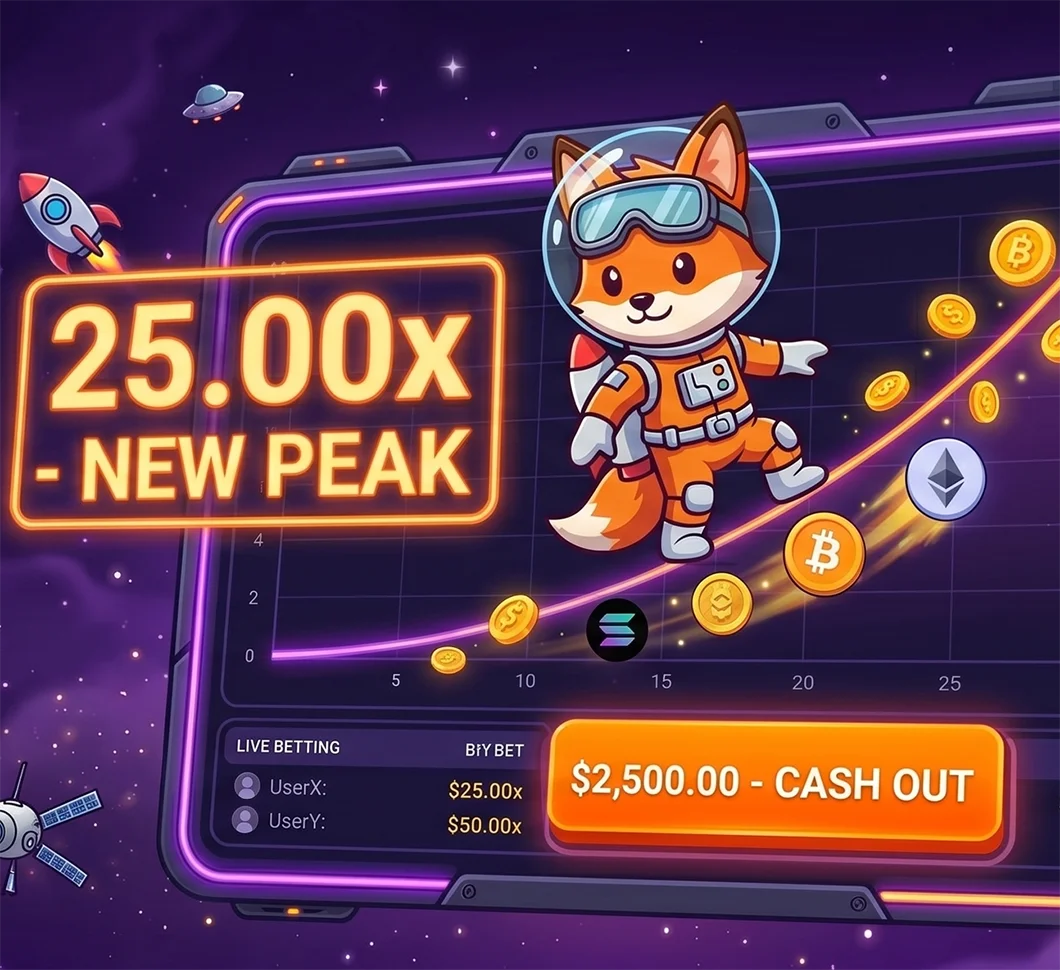
- Crash games: short-loop multiplier curve, simple to operate, fast sessions.
- Dice and limbo: lowest dev complexity, common as a launch title.
- Plinko and mines: visual variety on a simple RNG core.
- Slot games: highest art budget; usually built or sourced as a portfolio of 20 to 100+ titles.
- Card and table games: poker, blackjack, baccarat, roulette. More complex on the rule-engine side.
Frontend stack depends on the target platform. Browser-first products usually run on Phaser, PixiJS, or a React framework with WebGL canvases. Mobile-first products often use Unity for cross-platform builds. Slot art is delivered as a layered Spine 2D or DragonBones rig; see the slot game art service for the production scope.
A practical sequencing rule: launch with 1 to 3 provably fair native games (crash, dice, plinko) and an aggregated third-party slot portfolio rather than custom slots on day one. Custom slot development takes months per title; aggregator content is live in days.
Web3 social betting retention: leaderboards, reputation, notifications
Some crypto casino products use Web3-native social mechanics to support retention instead of relying only on standard loyalty programs. Three patterns can be considered during product scoping:
- On-chain leaderboards. Wagering volume, win streaks, or tournament rank are recorded as smart-contract state and surfaced publicly. Wallets are anonymous yet permanent, so leaderboard identity persists across sessions without a traditional account.
- Wallet-bound reputation. A player's wallet accrues reputation through participation (tournaments completed, days active, referrals brought in). Reputation can unlock VIP tiers or token rewards. Soulbound or non-transferable token (SBT) standards are common implementations.
- Wallet-event notifications. Push notifications fire on on-chain events: a deposit confirmed, a jackpot triggered, a tournament leaderboard change, a referred wallet placing its first bet. WalletConnect v2 and platform-specific push channels (XMTP, Push Protocol) are common transport layers.
These mechanics are technically straightforward but require deliberate design at the contract level (reputation needs to be SBT-compatible from the start; leaderboard contracts need rate-limiting against gas griefing). They also need a clear regulatory read: on-chain leaderboards may expose more player data than some licences allow.
Discuss your game scope with Game-Ace.
Step 6. set up KYC/AML and compliance infrastructure
Even a fully crypto-native casino is required to perform KYC and AML under most licensing frameworks. The Financial Action Task Force Recommendation 15 and the Travel Rule apply to virtual asset service providers, which includes crypto casinos in most regulated jurisdictions.
KYC/AML implementation usually uses one of:
- Sumsub. Common in CIS-adjacent and global markets; supports liveness checks, document parsing, sanctions screening, and ongoing monitoring.
- Jumio. Strong on regulated markets and PEP screening.
- Onfido. Used widely in the UK and EU markets.
For crypto-specific transaction monitoring, operators add a chain analytics provider:
- Chainalysis. The largest chain analytics platform; standard in regulated US and EU markets.
- TRM Labs and Elliptic. Both are commonly used as primary or backup providers.
KYC/AML is operator-side compliance work and is not part of game development scope. Game-Ace integrates with KYC providers at the frontend and session-management layer when the operator chooses one, but does not run, advise on, or sponsor compliance processes.
Step 7. QA, audit, certification, and launch

Three review steps usually run in parallel before mainnet launch:
- Smart contract security audit by an independent firm (CertiK, Hacken, ChainSecurity).
- RNG and game-logic certification by an accredited test lab (GLI-11 standard from Gaming Laboratories International, BMM Testlabs, or iTech Labs). On-chain provably-fair logic does not replace this certification under regulated frameworks.
- Functional QA: game logic, payout maths, wallet flows, load testing, anti-bot, anti-collusion (for table games).
A typical phased rollout starts with a closed testnet release, then a public testnet release with bounty incentives, then mainnet launch with a capped initial wallet count. Game-Ace runs functional QA and helps coordinate with audit and certification partners; the audit and certification themselves are independent third-party engagements.
About Game-Ace
Game-Ace is a custom game development company based in Cyprus, founded in 2005. The team includes 120+ in-house specialists across engineering, art, animation, and QA, with a portfolio of 200+ delivered projects since opening. The studio offers crypto casino game development covering smart contracts, provably fair mechanics, frontend, and art, and supports slot game art and broader full-cycle game development for operators that need more than the casino layer. Relevant crypto and iGaming references can be shared under NDA during project discussions. Selected public references are available on the Game-Ace portfolio page. If a studio or operator is scoping a crypto casino product and wants a development partner with a clear scope boundary, you can contact our team to discuss the project.
 Game predictions in sports: free-to-play formats that scale
  Crash games: what they are and how they're built
  3D and AI avatars in casino: how they boost acquisition, retention, and time-on-device
  Building a profitable online casino platform
  Social casino games: a B2B build guide