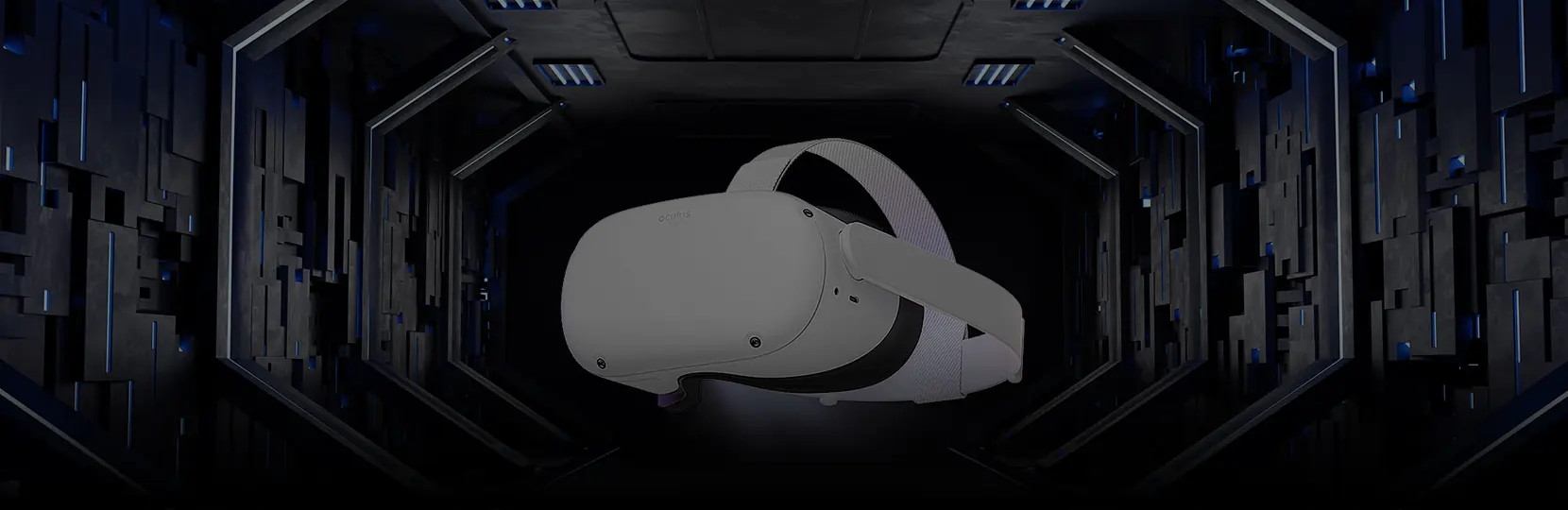

Oculus Quest game development covers design, engineering, art, and store delivery for the Meta Quest headset family. The active lineup is Quest 2 (2020), Quest Pro (2022), Quest 3 (2023), and Quest 3S (2024). Studios build in Unity or Unreal on top of the Meta XR SDK, ship through the Meta Horizon Store, and target 72, 90, or 120 Hz depending on device and content.
Meta Quest device lineup and what it means for Oculus Quest game development
The Meta Quest family is four active devices with two distinct hardware tiers. Quest 2 runs on Snapdragon XR2 Gen 1 with 6 GB of RAM and Fresnel lenses. Quest Pro adds pancake lenses, eye tracking, face tracking, and self-tracked controllers on a step up from that same generation. Quest 3 and Quest 3S share the Snapdragon XR2 Gen 2 SoC and 8 GB of RAM, which roughly doubles GPU headroom and enables full-colour Passthrough for mixed reality. Quest 3 keeps pancake lenses and a higher-resolution display, while Quest 3S returns to Fresnel optics at a lower price point.
For a studio scoping Oculus Quest game development, that split defines the performance budget. A title that targets the full lineup runs on Quest 2 rendering rules (aggressive draw call budgets, Fixed Foveated Rendering, careful use of MSAA), while Quest 3 and Quest 3S unlock higher pixel counts, richer shading, and mixed-reality mechanics using the Passthrough API.
| Device | SoC | RAM | Approx. launch price (USD) | Best fit |
|---|---|---|---|---|
| Meta Quest 2 | Snapdragon XR2 Gen 1 | 6 GB | $299 (discontinued 2024) | Legacy audience, lowest performance floor |
| Meta Quest Pro | Snapdragon XR2+ Gen 1 | 12 GB | $999-$1,499 range | Eye tracking, face tracking, prosumer MR |
| Meta Quest 3 | Snapdragon XR2 Gen 2 | 8 GB | $499 (128 GB) | Premium mixed reality, higher fidelity |
| Meta Quest 3S | Snapdragon XR2 Gen 2 | 8 GB | $299 (128 GB) | Mass-market mixed reality, entry price |
Planning a Quest 3, Quest 3S, or cross-headset title?
Engine choice for Quest game development: Unity or Unreal
Both Unity and Unreal Engine are first-class citizens for Meta Quest game development. Unity is the more common choice for Quest titles because of its mobile-forward pipeline, mature XR Interaction Toolkit, and a large pool of shipped Quest projects using URP. Unreal Engine 5 is a strong option when the project needs Nanite-adjacent geometry density on the wired PCVR side or high-end deferred lighting for Quest 3 tier content, though on-device it still runs Mobile Forward with careful shader budgets.
Engine choice depends on the team, the target frame rate, and whether the title is standalone-only or cross-headset. For a standalone Quest 3S build targeting 90 Hz, Unity with URP and the Meta XR SDK usually gives the fastest path to store submission.
- Unity: URP, XR Plug-in Management, XR Interaction Toolkit, Meta XR SDK, Addressables for asset streaming.
- Unreal Engine 5: OpenXR plugin, Meta XR plugin, Mobile Forward renderer, Instanced Stereo Rendering.
- Native / OpenXR: for teams shipping without a general-purpose engine, OpenXR plus Vulkan gives full control on Quest.
Meta XR SDK stack for Oculus Quest game development
The Meta XR SDK is the current entry point for building Quest titles inside Unity, and a matching plugin exists for Unreal. It replaced the older Oculus Integration package and ships as a set of modular UPM packages. The core is Meta XR Core SDK for tracking and rendering, extended by Interaction SDK for hands and controllers, Voice SDK for microphone and speech, Movement SDK for body and face tracking, and the Presence Platform for mixed-reality building blocks.
For mixed-reality features, the Mixed Reality Utility Kit sits on top of the Presence Platform and gives scene understanding, spatial anchors, and room mesh access. The Passthrough API renders the real-world camera feed underneath rendered content on Quest 3, Quest 3S, and Quest Pro. OpenXR remains the low-level runtime, which keeps titles portable between Quest, PCVR, and other OpenXR headsets.
Rendering targets: Vulkan, Mobile Forward, MSAA, and FFR
Quest is a Vulkan-first mobile GPU platform. Both Unity URP and Unreal Mobile Forward compile Quest builds against Vulkan by default. The standard fidelity levers on Quest are draw call count, shader complexity, MSAA level (usually 2x or 4x), pixel density, and Fixed Foveated Rendering. FFR reduces shader work in the peripheral view. On Quest Pro, that same feature runs as eye-tracked Foveated Rendering, which follows gaze rather than assuming the centre of the display.
Standard target on Quest 2 is 72 Hz for most titles, with 90 Hz as an opt-in mode for well-optimised content. Quest 3 and Quest 3S ship with 90 Hz as the default and support 120 Hz for titles that stay well inside their frame budget. Missing frame budget on standalone Quest is not soft; the compositor reprojects the last frame and users feel it as juddery motion.
Interaction, hand tracking, and voice
Meta Quest inputs cover Touch and Touch Plus controllers, hand tracking, and voice. The Interaction SDK gives ready-made grab, poke, ray, and locomotion primitives that work across controllers and hands with consistent behaviour. Hand tracking 2.x on Quest 3 and Quest 3S reads finger poses at up to 60 fps with low enough latency for direct manipulation, virtual keyboards, and system gestures.
Voice input runs through the Voice SDK on top of the Wit.ai backend. It supports wake words, dictation, and intent parsing without recording audio to disk on-device. Movement SDK exposes upper-body inverse kinematics on standard Quest and full body plus face tracking on Quest Pro. Teams that need to add specialist capacity for this layer often hire virtual reality game developers for a defined sprint rather than build the skillset in-house.
Spatial audio and Meta XR Audio
Spatial audio is a shipping requirement on Quest titles that place sound sources in world space. Meta XR Audio provides HRTF-based binaural spatialisation, room acoustics, and near-field effects with a lightweight CPU cost. It integrates with Unity as a spatializer plugin and with Unreal via the Meta XR Audio plugin.
For a mixed-reality title, spatial audio anchors virtual sources to real rooms scanned by MRUK. The result is closer to a diegetic experience because sound reflects off the scanned mesh rather than a generic reverb preset.
Packaging and Meta Horizon Store submission
A Quest title ships as an Android APK signed against a Meta Quest Developer Hub project. Meta Quest Developer Hub is the desktop tool for device deployment, log capture, performance metrics, and APK upload. Meta merged App Lab into the Meta Horizon Store, so there is now a single storefront with two visibility tiers set by review status rather than a separate side-catalog.
Store submission requires a Virtual Reality Check pass, correct manifest permissions, age rating, comfort rating, controller-and-hand support declaration, and health-and-safety copy. Meta reviews performance on the lowest supported device, which is still Quest 2 for most cross-generation titles. Rejection reasons cluster around frame drops on Quest 2, unclear locomotion options, and missing accessibility settings.
Performance targets and on-device QA
Frame time is the hard KPI on Quest. Meta publishes per-device performance budgets, and the Meta XR Simulator plus OVR Metrics Tool make it visible. A responsible test cycle runs on real hardware for every supported device, not only in the editor.
- Quest 2: 72 Hz default, 90 Hz optional, aggressive vertex and shader budget.
- Quest Pro: 72 or 90 Hz, eye-tracked FFR reduces shader load on peripheral pixels.
- Quest 3 and Quest 3S: 90 Hz default, 120 Hz for well-optimised titles.
- Passthrough MR: extra composition cost, plan for a 15-25% GPU overhead versus opaque VR.
- Thermal: sustained sessions on any Quest hit thermal throttling if peak GPU time is too close to the frame budget.
Cost and timeline for Oculus Quest game development
A single-mechanic Quest title with a few environments, one or two enemy types, and controller-plus-hands support usually sits in the €60,000 to €150,000 range and ships in 4 to 7 months. A full standalone Quest game with story, spatial audio, mixed-reality mode, and a full VRC pass usually falls between €180,000 and €600,000 over 8 to 14 months.
Cross-headset scope changes the math. Adding a PCVR build on top of a Quest project adds engineering, QA, and a second submission path on Steam. Adding Meta Horizon Store MR support requires MRUK integration, room-mesh QA, and a separate art pass on any content that reads through Passthrough. Related reading: VR game development cost and testing VR games.
Meta Quest projects in the Game-Ace portfolio
The Game-Ace VR portfolio covers original Quest builds and location-based simulation experiences. One reference sits close to Meta Quest scope.
Welcome to Star Archer VR, a standalone Meta Quest archery demo by Game-Ace
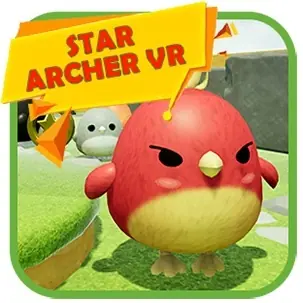
Star Archer VR is a wave-based archery demo built for the Meta Quest 1/2 generation, using bow-and-arrow motion controls and stylised low-poly environments to hold a stable frame budget on early standalone hardware. Game-Ace handled the full production: design, Unity engineering, art, sound, and demo packaging.
When to talk to Game-Ace about Oculus Quest game development
Game-Ace, a custom game development studio working on VR since the early Rift kits, builds Meta Quest titles under full-cycle, co-development, and team-extension models. In-house Unity and Unreal engineers, VR artists, and QA leads run the production, and every engagement includes NDA, IP transfer, and store submission support for the Meta Horizon Store. See our VR game development service page, or start with Unity game development and Unreal game development if you already know your engine, and full-cycle game development for turnkey production. Related reading: creating a VR game in Unity.
 How MetaHuman changes game character development
  Game development for startups: budget and MVP guide
  Engineering tower defense games from prototype to live service
  Idle game development: a full production guide
  Gamification in recruitment: what actually works