
Mobile sports games are competitive-play titles built for smartphones and tablets, spanning simulation football, arcade racing, sports prediction, manager formats, and multiplayer eSports variants. In production, mobile sports games sit between a live-service backend, a physics or math engine, and a monetisation layer that keeps sessions short and retention high. This article walks through sub-genres, cost, tech stack, and how Game-Ace scopes a mobile sports title from GDD to live ops.
If you are scoping a mobile sports title or a sports-prediction platform, talk to Game-Ace.
What actually counts as a mobile sports game
A mobile sports game is any title where the core loop simulates or references a real or fictional sport, played on iOS or Android with touch or tilt controls. The category is broader than licensed simulations: it includes arcade football like Score! Match, physics-based golf like Golf Blitz, retro-styled American football like Retro Bowl, and sports prediction titles where the loop is picking outcomes rather than controlling players.
The line between sports and racing is soft. Racing titles like Asphalt 9 are usually grouped with sports on the store side, and manager formats such as Football Manager Mobile behave more like tycoon or strategy games in production terms.
Which sports genres perform best on mobile
Football, basketball, and racing dominate global installs. Cricket has a strong regional footprint across India, Pakistan, Bangladesh, Australia, and the UK, with titles like Real Cricket and WCC leading long-tail retention. American football is a smaller but loyal segment where Retro Bowl showed a lean team can hit tens of millions of downloads without licensing.
Golf and tennis behave differently: shorter sessions, physics-driven, and monetisation leans on cosmetics plus tournament passes. Fantasy sports and prediction games sit in a separate bucket where the sport is real and the software is the operator layer.
Mobile sports sub-genres compared
The comparison below groups mobile sports games by production characteristics that matter when scoping. Audience, monetisation model, tech stack, and session length shift meaningfully between sub-genres, and each one implies a different team structure and delivery timeline.
| Sub-genre | Core audience | Monetisation | Session length |
|---|---|---|---|
| Simulation (football, basketball, cricket) | Fans of the real sport | Card packs, seasonal passes, cosmetics | 6-12 min |
| Arcade (Score! Match, Head Ball 2) | Casual competitive players | IAP, rewarded ads, ranked ladders | 2-5 min |
| Prediction / fantasy | Sports followers, betting-adjacent | Entry fees, subscriptions, ad revenue | 1-3 min per pick |
| Manager (Football Manager Mobile) | Strategy players, football fans | Premium price, DLC seasons | 20-45 min |
| eSports-oriented | Competitive core, streamers | Battle pass, cosmetics, tournament ecosystem | 8-15 min |
| Fantasy leagues | Statistically-minded fans | Contest fees, revenue share | 5-20 min per session |
How mobile sports games monetise
Free-to-play with IAP is the default for arcade and simulation formats. Simulation titles rely on card-pack economies with weekly refreshes; arcade titles lean on ranked ladders where cosmetic upgrades and battle passes drive ARPPU. Rewarded video ads remain a floor revenue layer, especially in emerging markets where IAP conversion is lower.
Prediction and fantasy formats monetise differently. Entry fees, contest rakes, subscriptions, and wallet top-ups replace card packs. That shifts the engineering priority toward wallet integration, KYC where regulated, and real-time sports data feeds. Manager formats sometimes sell as premium up-front titles with paid season DLC, which is closer to a console economy than a live mobile one.
Tech stack behind a production mobile sports game
Unity is the most common engine for mobile sports across simulation and arcade formats. It handles cross-platform builds, has mature physics for ball games, and integrates with the analytics and monetisation SDKs that publishers already run. Unreal is used when the visual bar is higher or when the same codebase serves a console port. Native Swift or Kotlin builds appear on lighter titles and prediction apps where the game layer is thin.
- Client: Unity with URP for cross-platform, or Unreal for higher-fidelity simulation.
- Backend: dedicated match servers on AWS or GCP, matchmaking service, ranked ladder store.
- Data: real-time sports feeds for prediction and fantasy formats.
- Monetisation SDKs: rewarded ads, IAP receipt validation, remote config for pricing.
- Analytics: session length, ranked progression, funnel drop-off per league tier.
- Live ops: seasonal event scheduler, remote-configurable card drop rates.
How much a custom mobile sports game costs
A focused arcade mobile sports title starts around €40,000 to €80,000 for a single-mode PvP loop with cosmetic monetisation. A simulation title with card economy, live tournaments, and cross-platform PvP typically ranges from €120,000 to €400,000 depending on team size and scope.
Prediction and fantasy platforms sit in a different bracket. The client-side app can be lean, but backend, real-time data feeds, wallet, and compliance push scope. Expect €80,000 to €250,000 for a first commercial build. For a deeper breakdown, see the Game-Ace guide on mobile game development cost.
What drives retention in mobile sports games
Session length and ranked structure matter most. If the first match is longer than 5 minutes in an arcade title, D1 retention drops. Ranked ladders with clear tier promotions produce a stronger week-2 hook than XP grinds. Seasonal card refresh is the retention engine for simulation formats.
Tournaments, friend challenges, and clan structures behave differently across genres. Prediction titles retain through daily contest scheduling and social leaderboards; simulation retains through squad-building; arcade retains through short sessions and cosmetic economy. Cross-platform play matters more in arcade and eSports-oriented sub-genres than in simulation.
How Game-Ace approaches a mobile sports project
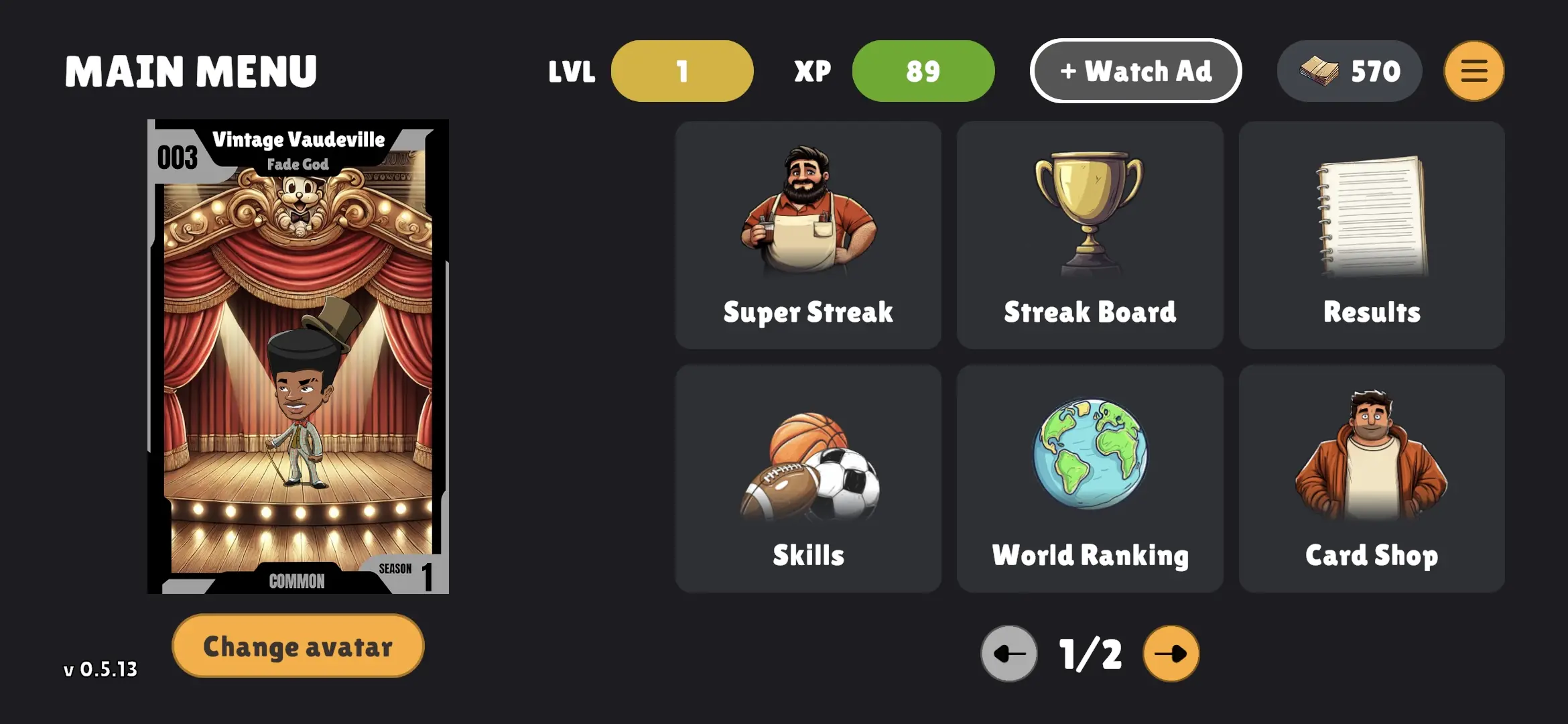
Every project starts with a scoping pass on sub-genre, target platforms, monetisation model, and licensing scope. For simulation titles this includes squad data structure and card economy math; for prediction platforms it includes wallet integration, KYC where relevant, and sports data feed selection.
From there we build a POC on the core loop, then an MVP with monetisation and progression, then scale to full production. Delivery models are team extension for studios that want engineers or artists inside their pipeline, co-development for a joint build with an in-house team, or full-cycle when the client owns only the brief. Cross-platform builds are handled through Unity mobile game development, or split Android game development and iOS game development when native performance dictates.
A selected mobile sports project by Game-Ace
Welcome to Cricket Manager, a mobile cricket MMO by Game-Ace

Cricket Manager is a mobile MMO where players train bowlers, manage club finances, and compete in league and cup play against friends and rivals worldwide. Game-Ace delivered the game logic and production for this cricket management simulation, running match calculation server-side to keep the client responsive.
Where the mobile sports market sits today
Mobile is the largest revenue segment of the global games industry, and sports remains one of the durable evergreen categories inside it. Market data from Newzoo tracks mobile revenue share across regions, and download analytics from data.ai show that football, cricket, and racing titles consistently appear in top-grossing charts across Europe, Latin America, and South Asia.
Licensed franchises like EA Sports FC Mobile and NBA 2K Mobile occupy the top-grossing tier, but the mid-market is where independent studios and Game-Ace partners typically operate: focused arcade titles, prediction platforms, cricket and football simulations for specific regions, and racing prototypes that scale into full releases. Related trends are covered in the Game-Ace review of mobile gaming trends.
When to talk to Game-Ace about a mobile sports game
If your roadmap includes a competitive mobile sports title, a sports prediction platform, or a cross-platform sports build, Game-Ace's game development studio can scope the POC, deliver full production, or extend your in-house team. Related guides: how to make a mobile game in Unity, multiplayer mobile game, and cross-platform mobile game development cover adjacent production questions.
 How to make a game app: a practical guide from idea to launch
  Best gaming platform: how to pick the right one
  Mobile gaming trends shaping the industry now
  Unity mobile game development guide
  Mobile game testing for iOS and Android: end-to-end guide