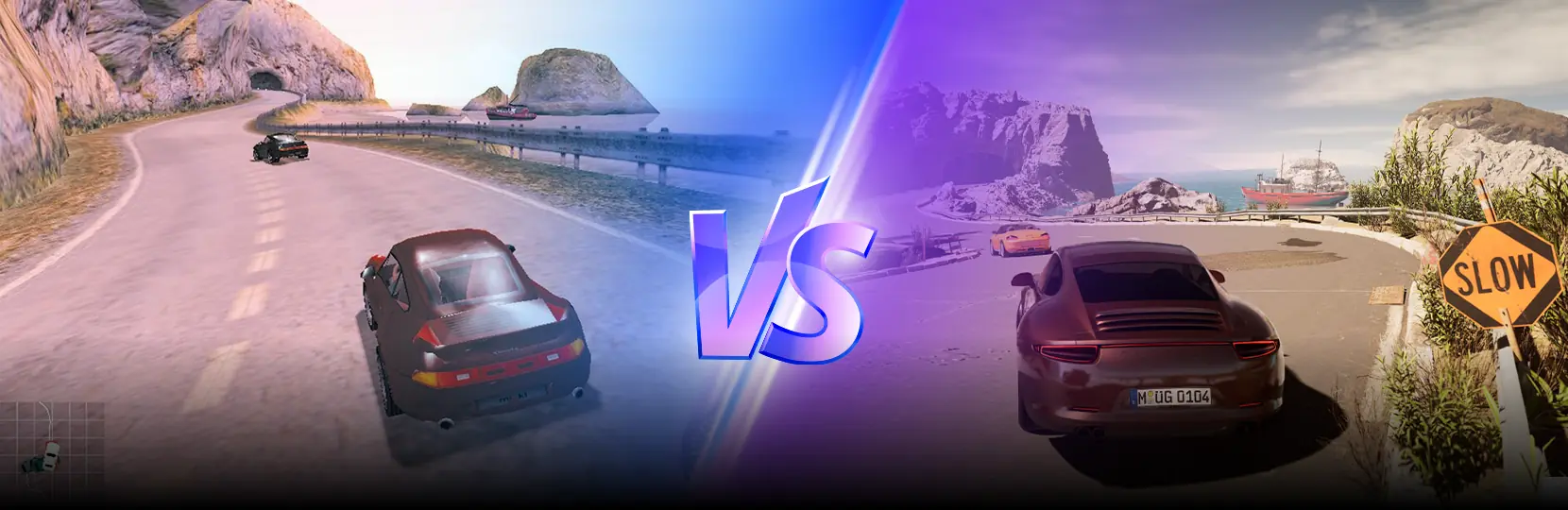

A video game remake rebuilds the original from scratch. New engine, new assets, redesigned systems, sometimes an expanded story. The source material is the reference point, not the original codebase. Resident Evil 4 Remake (2023) and Final Fantasy VII Remake are typical examples: the original premise survives, but the game files do not.
A video game remaster updates an existing game for modern hardware. The original code and assets are retained; the work focuses on resolution, frame rate, texture quality, audio, and platform compatibility. Tomb Raider I-III Remastered (2024) and The Last of Us Remastered are standard references.
The practical difference: a remaster is usually a months-long technical project, while a remake is a multi-year production with a budget and team profile closer to a new game.
Remake vs remaster at a glance
| Remake | Remaster | |
| Source code | Rebuilt from scratch in a new engine | Original code retained, lightly adapted |
| Art assets | Recreated from reference | Upscaled, re-rendered, or selectively replaced |
| Gameplay systems | Often redesigned | Unchanged or only patched |
| Story and structure | May be expanded or revised | Unchanged |
| Typical timeline | 2 to 5 years | 6 to 18 months |
| Typical budget level | High, comparable to a new title | Moderate |
| Example titles | RE4 Remake (2023), Silent Hill 2 Remake (2024) | TR I-III Remastered (2024), TLOU Remastered |
What is a video game remake?
A remake is a game rebuilt in a current engine using new assets, modern systems, and updated production standards. The original game serves as a design reference, but almost nothing from its code, art, or audio carries over directly. Story beats may be preserved, expanded, or reworked.
Silent Hill 2 Remake (October 2024) is a current-generation example. Bloober Team rebuilt the game in Unreal Engine 5, replaced the original fixed-camera framing with an over-the-shoulder system, and rerecorded the audio. Resident Evil 4 Remake (2023) is similar in scope: Capcom's RE Engine, redesigned combat, repositioned enemies, and modernised UI on top of the original story.
The Last of Us Part I (2022) is also a remake, not an enhanced port. Naughty Dog rebuilt the 2013 game on the Part II engine; the result is closer to a new production with a familiar script than to an upscaled re-release.
What is a video game remaster?
A remaster keeps the original game intact and improves how it presents on modern hardware. Common changes include higher resolution, stable frame rates, improved textures and lighting, remastered audio, and quality-of-life fixes such as modern controls or save systems. The original gameplay logic, level design, and story remain.
Tomb Raider I-III Remastered (February 2024) is a clean example. Aspyr preserved the original level geometry and gameplay rules while adding new textures, lighting, character models, and a modern control scheme alongside the classic tank controls. The Last of Us Remastered (2014) belongs to the same category: a hardware-jump update of the 2013 PS3 release rather than a rebuild.
Some recent projects sit on the boundary. Oblivion Remastered (2025) preserves the original Gamebryo logic for the game systems but renders everything through Unreal Engine 5. Bethesda calls it a remaster; parts of the industry argue it functions closer to a hybrid remake. The label often follows the marketing choice rather than a strict technical definition.
The key difference in one sentence
A remaster updates the presentation of the original game; a remake rebuilds the game itself.
Everything else (budget, timeline, team size, IP risk) follows from that choice. A remaster reuses the existing code and asset base, so the cost and schedule scale with the platform work involved. A remake starts from a blank engine and a design document, so it is closer to producing a new game than to porting an old one.
How studios choose between a remake and a remaster
The decision is rarely about which is "better". It depends on the state of the source material, the target platforms, and the commercial goals.
A remaster fits when the original game still plays well, the codebase compiles or can be adapted, and the main goal is to reintroduce the title on current hardware. Examples include Tomb Raider I-III Remastered and Burnout Paradise Remastered.
A remake fits when the original game is structurally dated, when the engine cannot be adapted, or when the publisher wants to expand the audience beyond fans of the original. Resident Evil 4 Remake and Silent Hill 2 Remake both fit this pattern: the originals remain influential, but their controls, camera systems, or pacing no longer match expectations of a current-generation buyer.
A third path exists in practice: the hybrid. Oblivion Remastered and Demon's Souls (2020, sometimes catalogued as a "remake from the ground up") show how publishers blur the line when the codebase is salvageable but the visual layer is not.
Examples worth knowing
Remakes
- Resident Evil 2 (2019, Capcom). Ground-up rebuild on RE Engine. New camera system, redesigned levels, full voice acting.
- Resident Evil 4 Remake (2023, Capcom). RE Engine. Reworked combat, repositioned encounters, expanded Ada Wong storyline.
- Final Fantasy VII Remake (2020) and Final Fantasy VII Rebirth (2024, Square Enix). Multi-part remake project on Unreal Engine 4; not a single release, more like a new game series built on the 1997 original.
- The Last of Us Part I (2022, Naughty Dog). PS5 and PC rebuild of the 2013 game on the Part II engine.
- Demon's Souls (2020, Bluepoint). Often grouped with remakes despite preserving original combat logic; the visual rebuild is total.
- Silent Hill 2 Remake (October 2024, Bloober Team / Konami). Unreal Engine 5. New camera framing, rerecorded audio.
Remasters
- The Last of Us Remastered (2014, Naughty Dog). PS4 update of the 2013 PS3 release.
- Burnout Paradise Remastered (2018, Criterion). Resolution and frame-rate update of the 2008 original, original gameplay preserved.
- Shadow of the Colossus (2018, Bluepoint). Sometimes labelled a remaster, sometimes a remake; visually rebuilt, logic preserved.
- Tomb Raider I-III Remastered (2024, Aspyr). New textures, lighting, and optional modern controls. Classic gameplay intact.
- Mass Effect Legendary Edition (2021, BioWare). All three games remastered as a single collection with technical and quality-of-life improvements.
- Star Wars: Knights of the Old Republic and its sequel have seen remastered ports across platforms while a separate remake project remains in production.
A useful test: read the credits. A remake has a full production team, including new directors, level designers, animators, and engine programmers. A remaster typically lists a smaller team led by a porting or technical lead.
Where reboots, ports, and resynced editions fit
- A reboot starts the franchise over. The story, characters, and tone are reset, even if a few names survive. God of War (2018) is the standard example: a new entry in the series that uses the same protagonist but resets the narrative direction.
- A port moves an existing game to a new platform with minimal changes beyond what the new hardware requires. PC ports of PlayStation titles or Switch ports of older console games belong here.
- Assassin's Creed IV: Black Flag has been remastered before and is now part of a project commonly referred to as Black Flag Resynced. "Resynced" is closer to a remaster than a full remake, with the gameplay loop preserved.
Cost and timeline, in rough terms
Public budgets are rare in this category, but the rough order of magnitude is consistent across the industry.
| Project type | Typical scope |
| Remaster | A remaster of a single PS3 or Xbox 360-era title typically takes 6 to 18 months and a small dedicated team; budgets often land in the low single-digit millions. |
| Remake | A remake of a major title typically takes 2 to 5 years and a full production team; budgets are in the tens of millions and sometimes higher when voice acting, motion capture, and new animation pipelines are involved. |
| Hybrid | A hybrid like Oblivion Remastered sits between the two: existing logic saves engineering time, but the rendering rebuild adds significant art pipeline and integration work. |
These numbers are industry estimates rather than published figures. The same title in different hands can land at very different scopes depending on what the publisher considers acceptable.
Production challenges that surprise newcomers
- Older codebases are usually built on engines and toolchains that no current studio uses day to day. Migrating a 2002 game to a current build pipeline involves recovering source files, reconstructing missing assets, and re-engineering middleware that no longer exists.
- Animation systems are a frequent friction point. A remake will recreate skeletons and rigs in current tools; a remaster usually has to live with the original animation set, which limits how much the visuals can be modernised without looking inconsistent.
- Licensing is the third common surprise. Music tracks, voice talent contracts, and engine middleware often need renegotiation. Several remasters have shipped without specific tracks from the original because the original licence did not survive.
About Game-Ace
Game-Ace is a B2B game development studio based in Cyprus, founded in 2005. The team includes 120+ in-house specialists across engineering, art, animation, and QA, and has delivered 200+ projects since opening. The studio works on full-cycle production, game co-development, and porting projects, including engine migration, asset conversion, and performance optimisation for current-generation hardware. Selected case studies are available on the Game-Ace portfolio page; deeper project credits are shared under NDA. If a studio or publisher is scoping a remake, remaster, or technical port and wants a production partner with experience across both lanes, you can contact our team to discuss the project.
A note on the terms in other markets
The same distinction comes up in non-English queries: diferencia entre remake y remaster (Spanish), perbedaan remake dan remaster (Indonesian), remake vs remaster farki (Turkish), unterschied remake remaster (German), remake co to (Polish), and the Cyrillic-script "remake i remaster" variants. The definitions in this article apply in each case: a remake rebuilds the game, a remaster updates the existing version.
 How MetaHuman changes game character development
  Game development for startups: budget and MVP guide
  Engineering tower defense games from prototype to live service
  Idle game development: a full production guide
  Gamification in recruitment: what actually works