
A game design document (GDD) is a living reference that describes what a game is, how it plays, and how it will be built. For outsourced production, the GDD is the shared source of truth that lets an internal team, an external studio, and QA work from the same scope, mechanics, art targets, and technical constraints without repeated re-briefing.
What a game design document actually is
A game design document sets out the concept, target audience, core mechanics, feature list, world, characters, systems, UI, monetization model, tech stack, and production milestones in one place. It is not a marketing artefact and it is not a business plan. It is a working document that producers, designers, engineers, artists, and QA return to during every sprint.
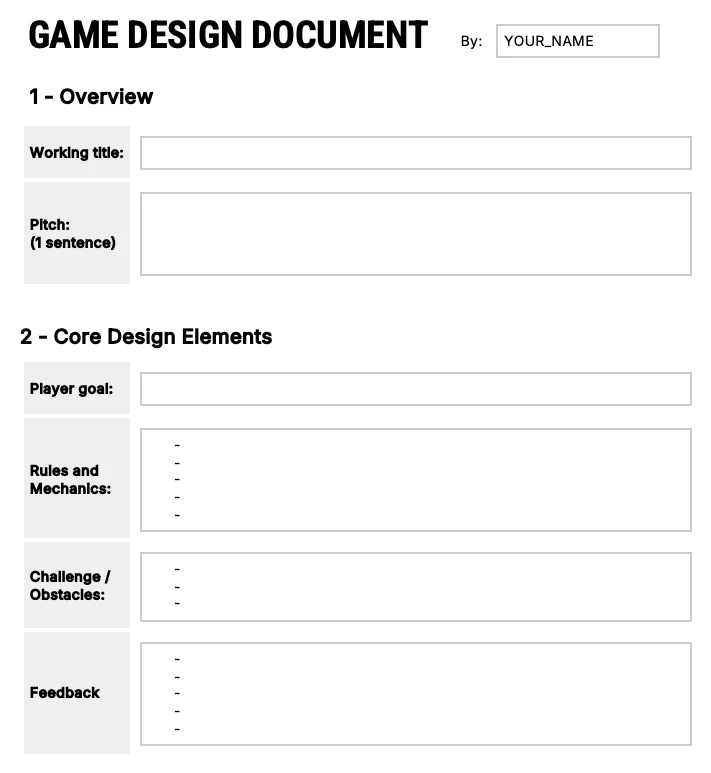
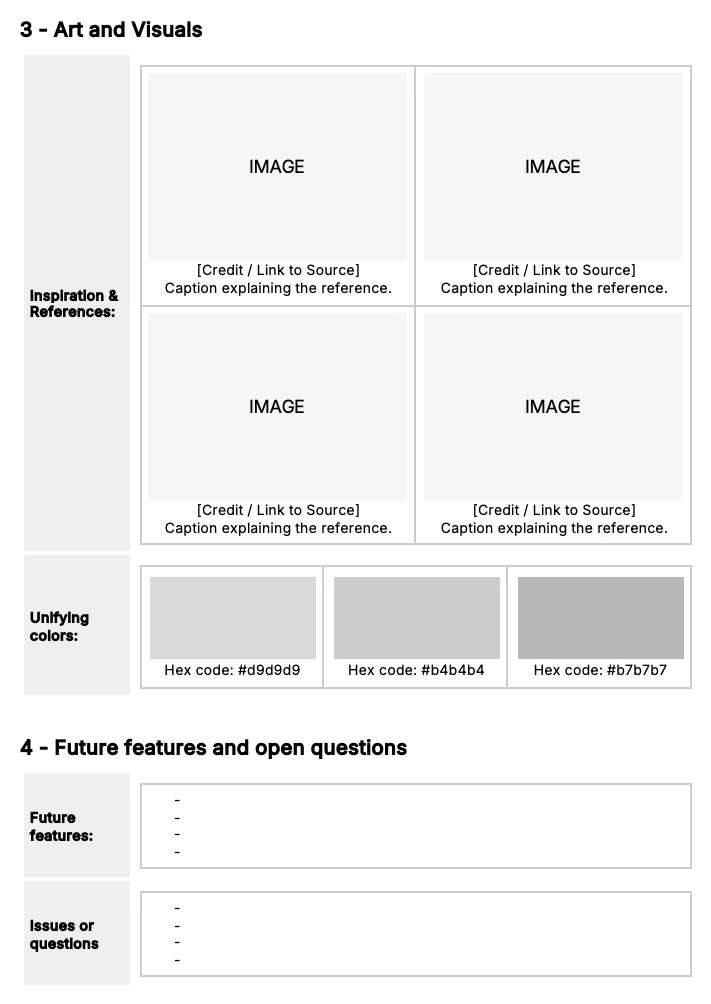
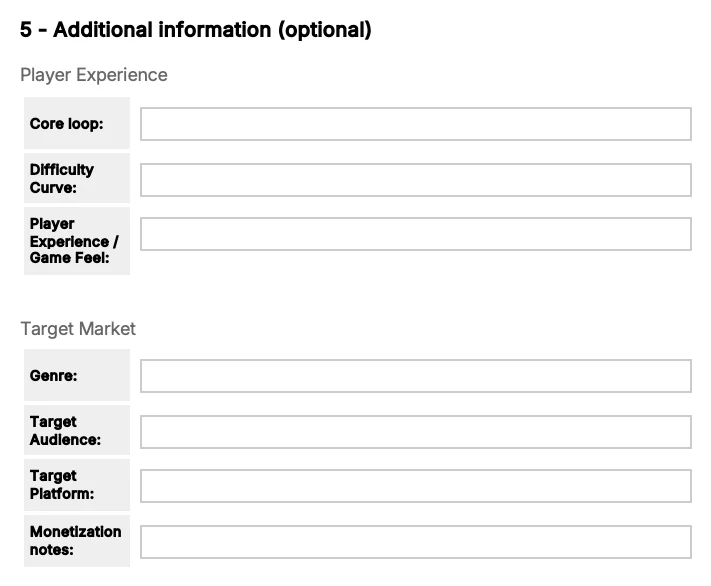
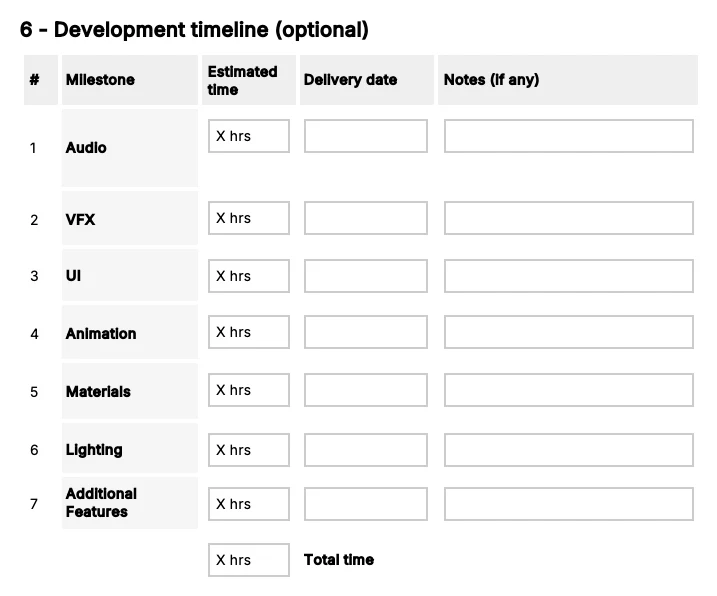
Template source: Unity Learn, Create a Game Design Document.
The purpose is practical. A well-written GDD reduces scope drift, makes estimates defensible, and shortens the loop between a design decision and its implementation. When a studio hands the document to an external partner for co-development or full-cycle production, the GDD is the artifact that keeps both sides aligned. Game-Ace uses the client's GDD, or writes one together with the client, before scoping any engagement.
GDD vs one-pager vs pitch deck vs TDD
These four documents are often confused, and mixing them up leads to weak briefs. A one-pager is a single-page summary written for internal alignment or a quick pitch. A pitch deck is a slide deck aimed at investors, publishers, or platform holders. A game design document is the internal production reference. A technical design document (TDD) is the engineering counterpart to the GDD and defines architecture, systems, data structures, and tooling.
| Document | Audience | Typical length | Purpose |
| One-pager | Internal team, quick external intros | 1 page | Fast alignment on concept and hook |
| Pitch deck | Investors, publishers, platform holders | 10-20 slides | Sell the opportunity and the team |
| Game design document (GDD) | Producers, designers, artists, QA | 20-120 pages | Production reference for the full game |
| Technical design document (TDD) | Engineers, tech leads, DevOps | 15-80 pages | Engineering architecture and systems |
On mid-scope projects, the GDD and TDD sometimes live in the same workspace with cross-links. On larger projects, the TDD is a separate document owned by the tech lead.
Sections a game design document should include
The exact section list depends on genre and scope, but a working GDD usually covers the same core areas. Skipping any of them tends to surface as a production blocker later.
- High concept: one-paragraph pitch, genre, platforms, unique selling points.
- Target audience: player persona, reference titles at a similar scope, market context.
- Core mechanics: verbs the player performs, feedback loops, progression.
- Feature list: shippable features grouped by MVP, v1.0, and post-launch.
- World and setting: art direction references, tone, narrative frame.
- Characters: main cast, enemies, NPCs, ability sets.
- Systems: economy, progression, quests, matchmaking, meta layers where relevant.
- UI and UX: screen flows, HUD, menus, onboarding.
- Monetization: business model, storefronts, in-app purchase design or premium pricing.
- Technology: engine choice, target platforms, key middleware, live-service backend.
- Milestones: production phases, deliverables per milestone, definition of done.
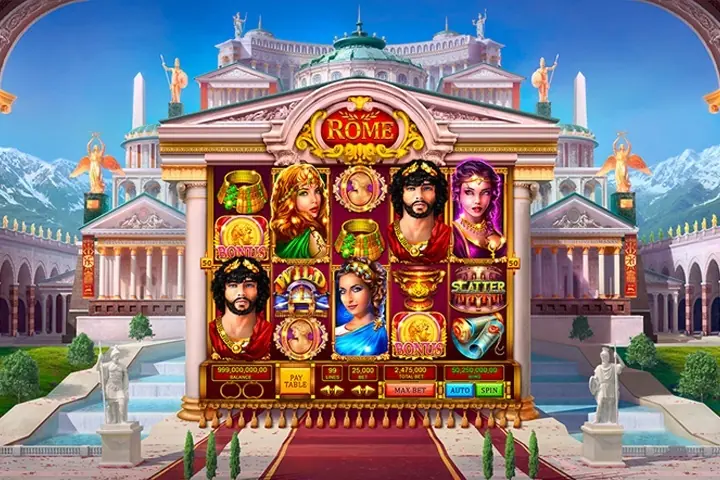
Genre changes the emphasis. A slot game GDD leans heavily on math models, RTP, volatility, symbol logic, and paytables. An MMORPG GDD spends most of its length on server topology, progression systems, and content pipelines. A hyper-casual mobile GDD stays short and puts most of its detail into onboarding and monetization.
How detailed a GDD should be
The right depth depends on scope, team size, and how much of the work is outsourced. A two-person prototype does not need a 100-page document. A team of thirty-plus with external contributors usually needs a detailed one. The rule that holds across projects: the GDD should contain enough detail that a new engineer or artist can join and be productive within a sprint without pulling a producer into every question.
Under-documented projects lose time to repeated conversations and diverging interpretations. Over-documented projects freeze early decisions that should stay flexible. Aim for the middle: detailed on mechanics, systems, and technical constraints; lighter on narrative flavour and art atmosphere where visual references do the heavy lifting.
GDD as a living document
Treat the GDD as a versioned working document, not a deliverable that is signed off once. Every meaningful design change should be reflected in the document within the same sprint. Version control, change logs, and clear ownership per section keep it honest.
Assign a single owner per major section. Designers own mechanics and systems. The tech lead owns the technology section. The producer owns milestones and scope. QA owns the acceptance criteria attached to features. Reviews happen at each milestone and after every scope change.
Tools for writing and maintaining a GDD
The tooling matters less than the discipline, but a few options come up repeatedly on projects Game-Ace works on.
- Notion: flexible pages, databases for feature lists, easy collaboration for small and mid-size teams.
- Confluence: enterprise-grade wiki, strong permissions, works well when the client already runs Atlassian.
- Miro: visual boards for system diagrams, progression maps, and early ideation.
- Nuclino: lightweight wiki with fast search, good for indie and mid-scope teams.
- Google Docs: still viable for early drafts and short GDDs, less scalable at production stage.
The picking rule is simple: use whatever the whole team, including any external partners, can access and edit without friction. See the public Notion template gallery for starting points.
Using a GDD for co-development and outsourced production
When an external studio joins the project, the GDD becomes the primary onboarding artifact. Game-Ace reads the client's GDD before scoping, flags gaps, and either fills them together with the client or asks for a short revision pass. A clean GDD shortens the estimation phase by weeks and reduces the number of change requests during production.
For a co-development handoff, three areas need special attention in the GDD: interface boundaries between the client's systems and the external team's systems, acceptance criteria per feature so QA on both sides agree on "done", and content pipelines so art and design assets flow the same way regardless of who authored them. Missing any of these is where co-development projects usually stall.
MVP scope framing inside the GDD
The GDD should mark clearly which features belong to the minimum viable product, which belong to the v1.0 launch, and which are post-launch. Without this split, teams tend to build every feature at the same depth, which stretches the schedule and buries the core loop. A working MVP list is short, testable, and forces early decisions on what the game is actually about.
On outsourced projects, the MVP split also helps engagement planning. A focused MVP is the natural scope for a Proof of Concept or first production sprint. The v1.0 and post-launch sections then feed into the roadmap that Team Extension or Full-cycle engagements plan against.
When to freeze the GDD
Full freeze is rarely realistic. What works is a tiered freeze. High-level scope (genre, target platforms, monetization model, core loop) freezes early, ideally before production starts. Mid-level systems (progression, economy, meta layers) freeze at the end of pre-production. Content parameters and tuning stay flexible until late in production and often into live operations.
Announce each freeze inside the document with a version tag and a short changelog. Anything that changes after freeze goes through a scope-change process with a producer sign-off. This is not bureaucracy; it is what prevents the last month of the project from turning into a rescope.
A Game-Ace portfolio case: production planning in practice
Welcome to Rome Slots, a cross-platform slot game by Game-Ace

Rome Slots is a cross-platform casino slot game built by Game-Ace on Cocos2d-JS with a proprietary PHP game server, planned end-to-end from concept and art through animation, with the design document defining reel math, bonus mechanics, and the Roman theme before production started.
Working with Game-Ace on a game design document
If you are preparing a game design document for outsourced production or a co-development handoff, talk to Game-Ace.
When to talk to Game-Ace about a game design document
A design document review or a joint GDD writing pass is usually the first step in scoping an engagement. Game-Ace works on GDD preparation together with clients across full-cycle game development, co-development, and Team Extension. If a game design document is on your roadmap, the Game-Ace custom game development studio can review the current draft, flag production risks, and help move the document to a scope-ready state.
 How to design learning games for kids
  Arcade game design: a production guide
  Game environment design for production-ready worlds
  Narrative game design: from concept to shipped story
  Game UX: a practical guide for studios and product teams