
MetaHuman changes game character development by helping Unreal Engine teams create realistic human characters faster with standardized rigs, facial animation support, real-time materials, and direct Unreal Engine integration. It works best for NPCs, prototypes, cinematic characters, simulations, and pitch builds, but it still requires custom art direction, animation cleanup, clothing integration, and performance optimization.
For game studios, MetaHuman is not an instant replacement for character artists or technical artists. It reduces part of the early setup work, then shifts production effort toward facial polish, LOD planning, groom settings, shaders, custom gear, and target-platform testing.
At Game-Ace, we help teams decide when MetaHuman fits an Unreal Engine game development pipeline and when a custom or hybrid approach gives better control over character identity, gameplay requirements, and performance budgets.
Need help with MetaHuman character development?
What is MetaHuman in game development?
To understand the impact, we have to look past the marketing. MetaHuman is not just a character customization menu. It is a production framework for creating, animating, and integrating high-fidelity digital humans, with MetaHuman Creator now available directly inside Unreal Engine. It gives teams a standardized character foundation, including body structure, facial rigging logic, materials, and animation compatibility that can be reused across multiple realistic human characters.
Epic Games defines MetaHuman as a framework for creating and using high-fidelity digital humans in real-time projects, which makes it especially relevant for Unreal Engine-based character pipelines.
What does this mean for a game character development lead? It means you are receiving a more predictable character foundation. When you pull a MetaHuman into Unreal Engine, you are not just getting a mesh. You are getting:
- Facial animation system. A production-ready facial rig that can support Live Link Face, ARKit-based capture, MetaHuman Animator, and Unreal Engine animation workflows.
- Standardized topology. A consistent mesh flow that helps textures and animations behave more predictably across different characters.
- Materials and shaders. Skin, eye, teeth, and hair materials designed for real-time rendering, but still requiring lighting checks and platform-specific optimization.
- Hair and groom setup. High-quality hair options that can look excellent in close-ups but require careful LOD, memory, and performance planning in gameplay.
- MetaHuman Creator. A character creation tool available inside Unreal Engine for building and editing high-fidelity digital humans before integrating them into gameplay, cinematics, or interactive scenes.
However, it is a mistake to view this as "instant characters." MetaHuman is a strong starting point. A studio still needs a technical art pipeline to handle clothing integration, specialized gameplay animations, asset cleanup, performance profiling, and optimization for target platforms.
How MetaHuman changes the character creation pipeline
In a traditional 3D character development pipeline, the process is often linear and sensitive to late changes. If a creative director decides to change a character's jawline after the rigging phase, the team may need to return to the sculpt, update textures, check facial movement, and potentially revise the game character's skinning, which controls how the mesh deforms during movement.
A MetaHuman workflow makes parts of this process more flexible. Because the underlying character framework handles many proportions and rigging standards, teams can iterate on a character's look with less disruption to the rig. This makes it easier for narrative, art, animation, and technical teams to test character changes without restarting the whole pipeline.
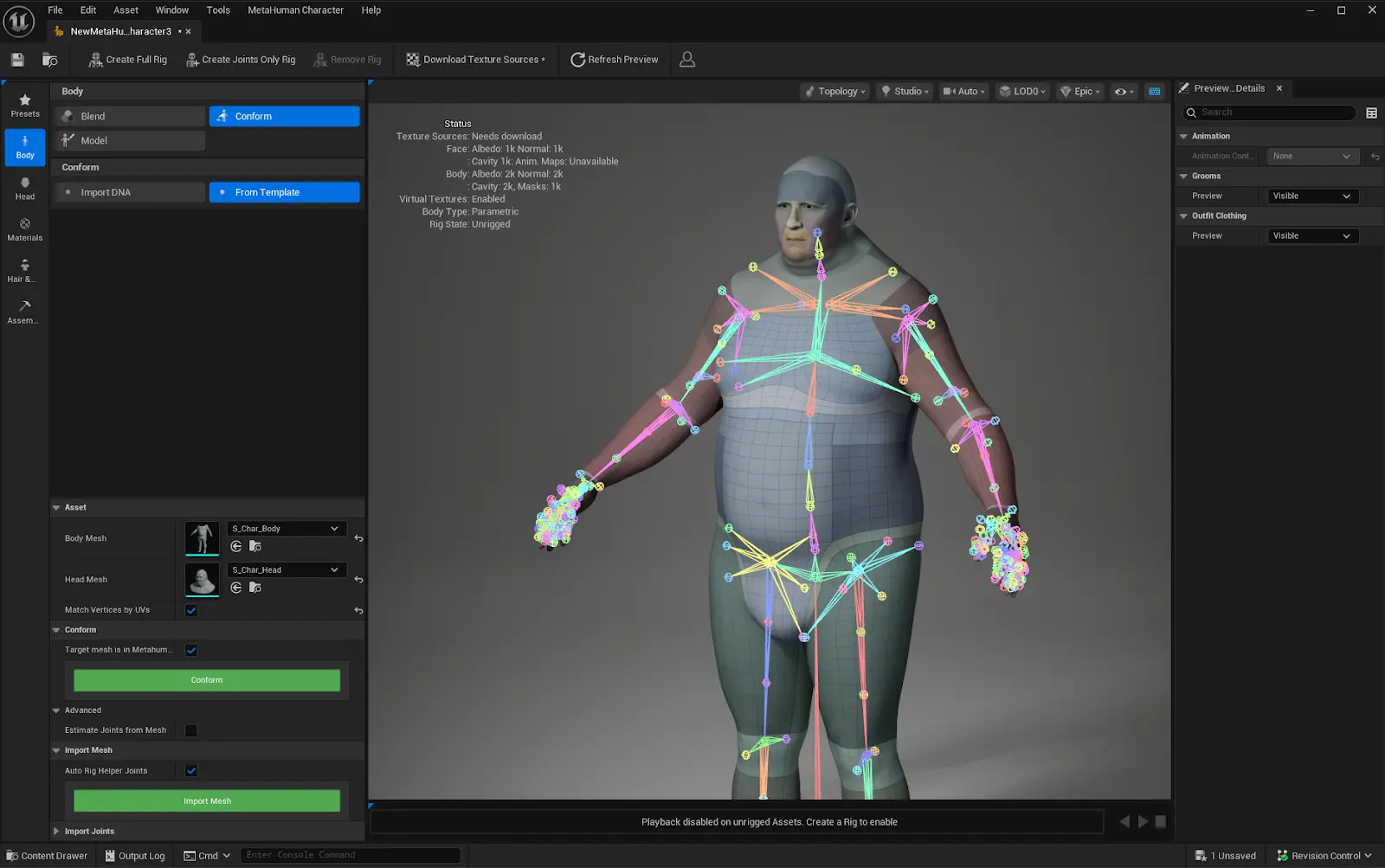
Workflow comparison: the old way vs. the MetaHuman way
| Production stage | Traditional custom pipeline | MetaHuman-assisted pipeline | Production note |
| Asset base | Fully custom sculpt, model, and rig. | MetaHuman-generated base with custom art direction, clothing, and optimization. | MetaHuman speeds up the starting point, but does not replace character design. |
| Topology | Manual retopology and LOD planning. | Standardized topology with built-in LOD options. | Still requires testing for target platforms and camera distances. |
| Rigging | Custom skeleton, skinning, facial rig, and deformation testing. | Standardized rig foundation with project-specific validation. | Clothing, gameplay movement, and close-up animation still need review. |
| Facial setup | Custom facial rig, blendshapes, and expression testing. | MetaHuman facial system with capture support and cleanup. | Strong base, but professional scenes still need animation polish. |
| Iteration | Late changes can affect sculpt, rig, textures, and animation. | Faster visual changes within one standardized framework. | Useful for prototypes, vertical slices, and narrative testing. |
| Clothing & gear | Fully custom clothing, accessories, and attachment setup. | Custom clothing and gear built around the MetaHuman body and rig. | Armor, cloth, weapons, and props can still become major workload areas. |
| Optimization | Fully custom LODs, shaders, materials, and profiling. | Built-in LOD options plus project-specific profiling, material planning, and platform tuning. | Performance is still the main production risk. |
Official Unreal Engine example: the Indie Games Week 2026 session shows how small teams can use MetaHuman workflows to create, capture, retarget, and animate high-fidelity digital humans directly in Unreal Engine. The video is relevant for game developers because it focuses on accessible production methods, smaller budgets, real-time workflows, and practical character animation pipelines.
Faster prototyping for realistic characters
The ability to move from a character concept to an early animated prototype much faster changes how teams test realistic characters during pre-production. For game development for startups, this can be especially useful. Instead of committing a large portion of the early budget to a single fully custom hero character, a small team can prepare several digital human characters for testing narrative beats, dialogue scenes, or gameplay interactions.
This speed helps with vertical slices, pitch builds, internal playtests, and early investor demos. It also lets teams identify animation, lighting, camera, and performance issues before the project has locked its full character pipeline.
Reduced rigging and facial setup work
Character rigging for video games is often one of the most difficult parts of game animation pipelines. By standardizing the rig, MetaHuman reduces the amount of custom facial system work required at the beginning of production. This does not mean you do not need riggers. It means riggers and technical artists can focus more on project-specific problems, such as how a character's heavy armor interacts with the shoulders, how facial animation behaves in close-up shots, or how accessories stay stable during gameplay.
Better iteration between art and development teams
A standardized character base also improves communication between art and engineering teams. Instead of debating every technical layer from scratch, teams can evaluate LODs, materials, groom settings, animation budgets, and target hardware earlier in production.
MetaHuman and realistic game characters
High fidelity has a practical downside. The closer a character gets to realism, the more visible weak animation, poor lighting, or incorrect facial timing becomes. MetaHuman game character development gives teams a strong visual base, but performance quality still depends on acting direction, animation cleanup, camera work, and technical polish.
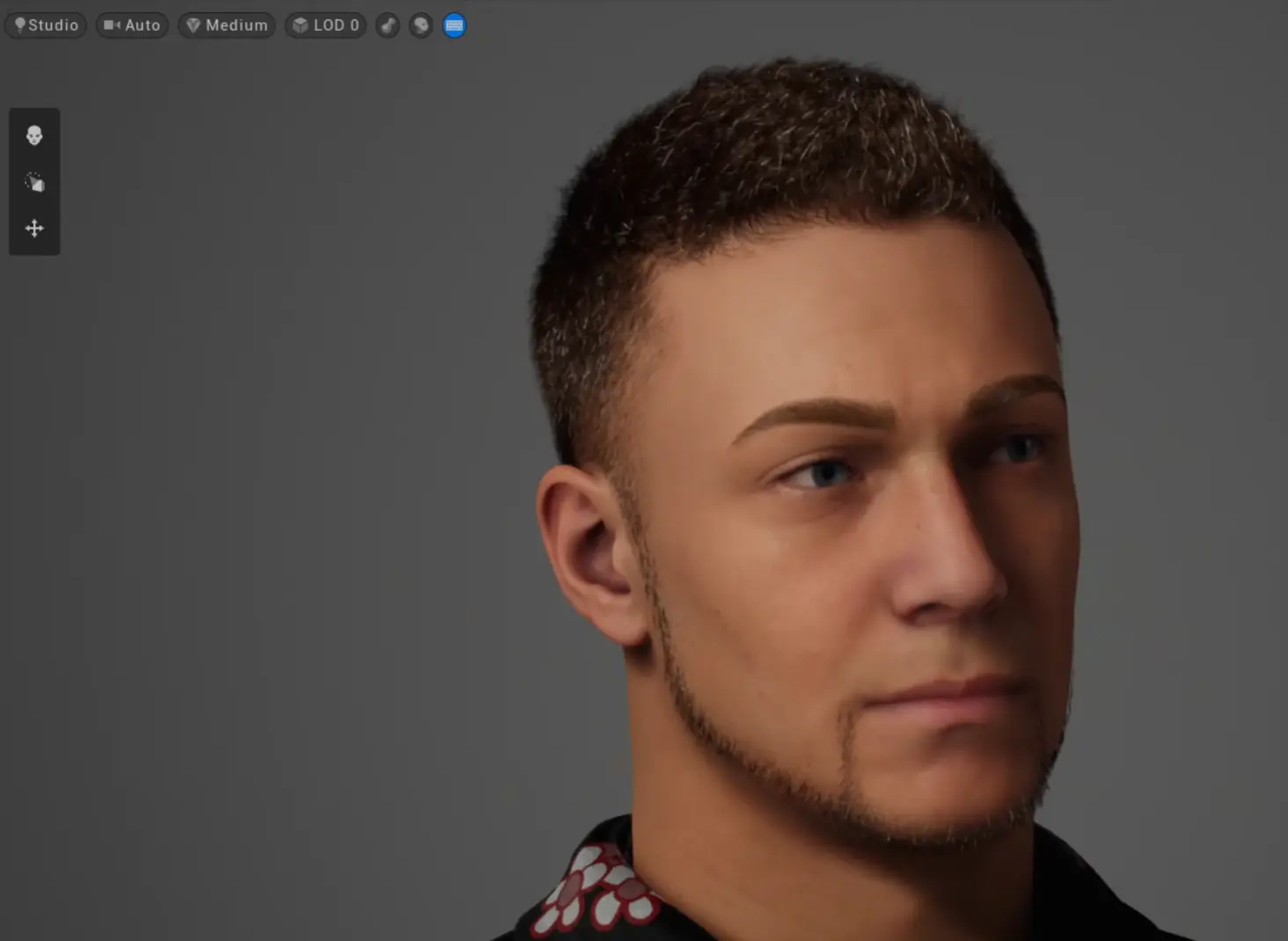
Facial animation and performance capture
The standard MetaHuman rig is designed to support motion capture for games. Using tools like Live Link Face, an animator can capture a facial performance on an iPhone and preview it on a high-fidelity character in Unreal Engine.
However, professional-grade facial animation still requires a human touch:
- Refinement. Automatic capture can miss subtle expression changes, especially when a scene depends on emotion, hesitation, tension, or personality.
- Lip-syncing. Automated tools help, but manual cleanup is often needed for dialogue-heavy RPGs, cinematic scenes, and close-up conversations.
- Corrective shapes. For extreme expressions, a technical artist may still need to adjust deformation behavior so the face does not break during strong jaw, cheek, or eye movement.
Body animation and motion quality
Since MetaHumans share a common skeleton, teams can reuse or retarget existing Unreal Engine animations more easily than they could with fully custom characters. But animation still needs direction. A battle-hardened soldier, a tired detective, and a nervous witness should not move in the same way, even if they share the same base character system.
Body animation still needs locomotion setup, pose correction, motion matching or blend spaces where relevant, interaction animations, combat movement, and cutscene-specific performance work. Game animation is about behavior, not just rig compatibility.
How MetaHuman works with Unreal Engine
The synergy between MetaHuman and Unreal Engine is what makes the technology viable for B2B production. Recent MetaHuman updates have expanded the platform beyond the old web-based workflow. MetaHuman Creator is now available directly inside Unreal Engine, while recent updates continue to improve body conforming and character customization workflows, giving teams more flexibility when adapting custom meshes, body poses, and production-ready digital humans. For Unreal Engine projects, however, the integration remains especially direct and production-friendly.
Technical integration mapping
Unreal Engine's rendering tools, including post-processing settings, help teams test how exposure, lighting, skin materials, and camera behavior affect a MetaHuman across different environments. This matters because a character that looks convincing in a studio lighting setup may look inconsistent in a dark corridor, open-world daylight scene, or fast-moving gameplay camera.
Where MetaHuman works best in game projects

Not every project is a fit for this technology. In our experience at Game-Ace, MetaHuman works best in projects where realism, human presence, and facial performance directly support the player experience.
Primary use cases
- Narrative-driven RPGs. Facial nuance during dialogue scenes can help players connect with characters, choices, and story consequences.
- Simulations and training. B2B applications often benefit from realistic instructors, patients, workers, or virtual colleagues to create believable human interaction.
- Visual novels and cinematic adventures. Projects with a strong focus on conversations, camera work, and emotional delivery can benefit from high-fidelity digital human characters.
- High-end NPCs. Realistic open worlds, detective games, social spaces, and narrative hubs can use MetaHuman for important non-playable characters.
- Interactive demos and pitch builds. Studios can create a stronger visual representation of a project before committing to a full custom 3D character pipeline.
For a studio, using MetaHuman in these contexts can reduce some of the base work usually associated with 3D character modeling, leaving more room for custom clothing, specialized gear, animation polish, and environmental storytelling.
Where custom character development is still a better choice
As a production choice, MetaHuman is not always the best answer. It is a tool, not a replacement for art direction. Custom game characters remain the stronger option for projects that require a highly specific visual identity, an unusual body structure, or a non-realistic design language. In these cases, companies may need to hire character designers to define the visual direction before modeling, rigging, and animation begin.
MetaHuman may not be the right choice if:
- You are building a stylized game. If your game is cel-shaded, low-poly, exaggerated, or heavily art-directed, the realistic anatomical constraints of MetaHuman may work against the style.
- You have non-human characters. The MetaHuman DNA system is built around humans. If your main character is a goblin, a robot, a creature, or a hybrid species, you need a custom character creation pipeline.
- You have strict performance constraints. Mobile-first games, web-based experiences, or large-scale multiplayer scenes with many visible characters may require lighter custom assets.
- You need unusual proportions. If a character needs a body type, face shape, limb structure, or silhouette far outside realistic human proportions, a custom rig may be more practical.
- You use a non-standard pipeline. If your production uses Unity, Godot, a custom engine, or a non-standard content pipeline, MetaHuman may still require additional validation, export planning, licensing review, and technical testing before it becomes a practical choice.
In these cases, Game-Ace can build custom pipelines from the ground up. The goal is to preserve the art style while still using modern animation tools, technical art practices, and production methods that keep development efficient.
Technical challenges in MetaHuman game character development
The "out of the box" experience with MetaHuman can be misleading. A single character in a test scene is not the same as a full game production with environments, gameplay systems, UI, lighting, multiple NPCs, build constraints, and platform requirements. Technical directors should account for these issues early.
Performance optimization: the real bottleneck
A high-detail MetaHuman can be expensive in real-time scenes. The game character development team must make practical trade-offs to protect the target frame rate:
- Groom vs. cards. The team must decide when to switch from strand-based hair to cards or mesh-based representations. Close-up cinematics may justify higher-quality hair, while gameplay cameras often require lighter LOD settings.
- Texture memory. High-resolution skin textures can increase memory usage quickly, especially when several characters appear in the same scene.
- Draw calls. Every clothing item, material slot, and accessory adds complexity. Without material planning, mesh merging, or other technical artwork, draw calls can become a performance issue in scenes with multiple actors.
- Physics complexity. Cloth simulation, hair movement, and accessory physics can increase CPU and GPU costs, becoming noticeable when several characters are active at once.
Customization and "same-face" risk
Because many projects start from the same MetaHuman ecosystem, there is a risk that characters may look too familiar if the art team relies only on default options. To avoid this, texture artists, character artists, and technical artists should adjust skin details, scars, makeup, clothing, silhouettes, accessories, hair, and animation behavior.
The goal is not just to create a realistic person. The goal is to create a character who belongs to the game's world.
Pipeline management and versioning
MetaHumans are complex assets. In a long production cycle with multiple artists, animators, and developers, managing MetaHuman versions can become a significant pipeline challenge. If the production updates Unreal Engine, MetaHuman assets, plugins, or animation workflows, the team needs to check whether those changes affect rig behavior, animation data, clothing, materials, or build stability.
This is why naming conventions, source control, documentation, and technical art review matter. MetaHuman can speed up character creation, but it also adds a specific asset-management layer to the production pipeline.
Need to validate a MetaHuman pipeline before production? Game-Ace can assess character complexity, animation scope, target platforms, and optimization risks before your team commits to a full workflow.
Deep dive: the role of technical art in MetaHuman implementation
The biggest misconception about MetaHuman is that it is plug-and-play. In reality, a technical art pipeline becomes more important, not less. When you bring a MetaHuman into a project, you introduce a complex character structure that needs to integrate with your gameplay, animation, rendering, and build systems.
Custom clothing and attachment systems
MetaHuman comes with a default set of clothes, but for a professional game, you need bespoke armor, outfits, and accessories. A 2025 80 Level breakdown of Aitziber Azkue's Drip Fit for a King project shows that MetaHuman-based character work still relies on traditional DCC tools, including ZBrush, Maya, Marvelous Designer, and Substance 3D Painter, for sculpting, armor, cloth, and texture production.
This process involves:
- Clothing creation in Marvelous Designer. Building garments with realistic folds and proportions before refining, retopologizing, and integrating them into the Unreal Engine pipeline.
- Weight painting. Ensuring the clothing moves correctly with the MetaHuman skeleton.
- Socket management. Setting up sockets for weapons, backpacks, tools, and accessories so they stay aligned during animation.
Custom DNA and mesh to MetaHuman
For many studios, the standard MetaHuman faces are not enough. They may want to use a specific actor's likeness, a custom sculpt, or a face concept developed by the art team. MetaHuman Identity workflows allow teams to use an existing mesh, scan, or performance source as the basis for a more customized digital human. This can help connect a custom face concept or actor likeness to the MetaHuman system, but the result still depends on scan quality, facial landmarks, proportions, and animation cleanup.
That process still requires careful preparation. Facial landmarks, proportions, eyes, mouth, scan quality, and topology alignment all affect how well the final character performs in animation.
Business benefits of MetaHuman for game studios
For studios and startups, the main value of MetaHuman is not "instant character production." It is faster validation, a more predictable technical foundation, and better use of specialist time. MetaHuman can reduce some of the early uncertainty around realistic human characters, but teams still need custom art direction, animation cleanup, optimization, and pipeline control.
| Benefit | What it means in production |
| Faster prototyping and vertical slices | Teams can create realistic human characters earlier for pitch builds, internal demos, narrative tests, and gameplay prototypes. |
| More predictable base character setup | MetaHuman provides a standardized foundation for faces, rigs, materials, and animation workflows, reducing some early pipeline risk. |
| Better allocation of specialist talent | Artists and technical artists can spend less time on repetitive setup and more time on custom clothing, animation polish, gear, shaders, and optimization. |
| Scalable production for realistic NPCs | Teams can build a wider range of realistic human characters faster, while still adjusting faces, clothing, silhouettes, materials, and behavior to avoid a generic look. |
MetaHuman can help a project reach a stronger visual baseline earlier, especially for narrative games, simulations, cinematic demos, training products, and character-heavy Unreal Engine projects. However, it does not remove the need for technical art leadership. Performance, memory usage, groom settings, material complexity, and animation quality still need to be planned before full production begins.
Key features teams need around MetaHuman characters
If you are building a project around these characters, you cannot just import and play. There is a list of surrounding features that require professional development to make the characters feel like they belong in a game world.
The production checklist
- Animation retargeting. A system to adapt existing animations to MetaHuman proportions while checking foot placement, hand poses, interaction points, and gameplay transitions.
- Facial performance pipeline. Hardware and software setup for facial capture, data review, cleanup, and export into the game animation pipeline.
- Physics-based interaction. Systems that help characters step correctly on uneven terrain, react to physical hits, carry items, and interact with gameplay spaces.
- Dialogue and cinematic integration. A pipeline that connects facial animation, voice lines, camera work, subtitles, dialogue trees, and scene logic.
- Optimization profiles. Different performance settings for target platforms, scene types, camera distances, and character counts.
- Build pipeline integration. A process for cooking, compressing, validating, and testing high-resolution character files in production builds.
Each of these points can become a failure point if addressed too late. This is why many studios choose to engage an experienced game art outsourcing partner like Game-Ace. The goal is to integrate the character pipeline while the core team keeps focus on gameplay, product goals, and production milestones.
MetaHuman vs. custom character development: the decision matrix
The choice is not binary. Many projects use a hybrid strategy. MetaHuman may work well for realistic NPCs, prototypes, cinematic supporting characters, or fast iteration. Custom character development may be better for hero characters, stylized games, unusual proportions, or very specific art direction.
| Feature | MetaHuman strategy | Custom pipeline strategy |
| Visual style | Best suited for realistic human characters. | Supports stylized, realistic, non-human, or exaggerated designs. |
| Production cost & scope | Reduces some early setup work for faces, rigs, and materials. | Requires more upfront work, but gives full creative and technical control. |
| Iteration & approval | Allows faster visual iteration within a standardized framework. | Slower to revise, especially after sculpting, rigging, or animation begins. |
| Rigging & animation | Provides a standardized human rig, but still needs testing and cleanup. | Requires custom rigging, skinning, facial setup, and deformation testing. |
| Engine & platform fit | Strong fit for Unreal Engine projects, with platform-specific optimization still required. | More flexible across engines, platforms, and custom pipelines. |
| Character identity | Needs strong art direction to avoid a generic or familiar look. | Easier to create a fully unique character, silhouette, and style. |
| Best use case | Realistic NPCs, prototypes, cinematic characters, simulations, and vertical slices. | Hero characters, stylized games, creatures, unusual proportions, and premium custom identities. |
Expert recommendation: For realistic NPCs, prototypes, and cinematic supporting characters, MetaHuman can be a practical starting point. For hero characters, stylized games, creatures, or projects with a very specific visual identity, a custom pipeline often gives the team more control through custom sculpting, bespoke materials, and stronger art direction. In many productions, the strongest option is a hybrid approach: MetaHuman for speed and standardization, custom character development for identity and style.
MetaHuman vs. Unity for character creation: how the pipelines differ
MetaHuman is Unreal Engine's first-party photorealistic human creation system. Unity does not ship a first-party equivalent. Teams on Unity who want a comparable workflow typically combine Character Creator 4 from Reallusion (the closest functional match, paid, with cross-engine export), ReadyPlayerMe (avatar-first, free SDK, cross-engine), and selectively Unity Muse (AI-assisted, but not a full character system). Synty Studios fits a different segment and ships stylized characters rather than realistic.
The practical difference is not "MetaHuman or no MetaHuman". The difference is whether the team accepts the engine commitment that comes with MetaHuman, and whether the project needs photorealistic humans at all.
| Category | MetaHuman (Unreal) | Unity character tools |
| First-party tool | Yes, free with Unreal Engine 5 | No first-party equivalent; teams use Character Creator 4 (paid) or ReadyPlayerMe (free SDK) |
| Visual style | Photorealistic humans only | Realistic via CC4; stylized via Synty; avatar style via ReadyPlayerMe; AI-assisted via Unity Muse |
| Engine lock-in | Originally Unreal-only; since mid-2025 Epic licence allows export to Unity and Godot | Engine-agnostic by design across most tools |
| Rig and animation | Standard MetaHuman rig, Control Rig, Live Link Face for iPhone facial mocap | Tool-dependent; CC4 ships a humanoid rig compatible with Unity Mecanim; ReadyPlayerMe uses a simpler avatar rig |
| Cross-engine portability | Export workflow exists since 2025 licence change, but rigging and material setup may need adjustment per engine | CC4 and ReadyPlayerMe were built for portability; less rework on engine switch |
| Cost | Free tool; production cost is in the technical art and integration around it | CC4 has license tiers; ReadyPlayerMe has free SDK; Unity Muse is subscription |
| Best fit | Realistic hero or NPC humans in Unreal-first projects, or projects ready to absorb cross-engine integration work | Stylized characters, fast avatar systems, multi-engine pipelines, or Unity-first projects |
Cross-engine use of MetaHumans
In mid-2025 Epic Games updated the MetaHuman licence to allow MetaHumans to be exported and used in other engines, including Unity and Godot. This is a meaningful change for studios that prefer Unity's tooling or runtime but want MetaHuman-level fidelity on a few hero characters. The export workflow is technically real, but in practice rig setup, material conversion, and animation compatibility usually need an extra technical-art pass. The cost saving compared with building a custom photorealistic human is still significant; the integration is no longer "free".
MetaHuman Creator web app sunset
Epic announced that the web-based MetaHuman Creator is being retired in 2026, with creation tools moving into the Unreal Engine 5 plugin. Studios that built MetaHuman pipelines around the web app are migrating to the local Unreal workflow. The shift removes the cloud-dependency that some studios flagged as a security concern, and consolidates MetaHuman creation inside the engine. Teams evaluating MetaHuman in 2026 should plan around the plugin workflow, not the legacy web tool.
Which pipeline fits which project
A simple decision rule covers most cases:
1.Photorealistic humans, Unreal-first project: MetaHuman is the strongest starting point. Most of the work shifts from sculpting to technical art around the rig.
2.Photorealistic humans, Unity-first project: MetaHuman is now an option after the 2025 licence change, but Character Creator 4 from Reallusion usually wins on workflow simplicity inside Unity. Mixing both - MetaHuman for hero characters, CC4 for crowds - is a legitimate pipeline.
3.Stylized characters: neither MetaHuman nor CC4 is the right starting point. Synty Studios assets, Unity Muse for AI-assisted generation, or a custom stylized pipeline are stronger fits.
4.Avatar or social-experience characters: ReadyPlayerMe is built for this segment and ships a cross-engine SDK.
5.Mixed projects (Unreal hero, Unity client, or both): the team takes the integration cost into account from day one rather than locking the pipeline to a single tool.
Game-Ace works across both pipelines and integrates with Unity game development and Unreal Engine game development projects as part of broader game art and design engagements. The right pipeline is the one that matches the project's visual target and engine commitment, not the one with the strongest marketing.
How businesses can decide whether to use MetaHuman
Before your technical director signs off on a MetaHuman-heavy project, ask these tactical questions during your next strategy meeting:
- What is our "Minimum viable realism"? Do we actually need a high-fidelity facial rig, or would a simpler setup be enough for our art style and camera distance?
- What is our lowest common denominator for hardware? If you are targeting mobile devices, older consoles, the web, or low-end PCs, MetaHuman requires careful performance validation.
- Do we have the technical art talent to optimize? If the team lacks experience with draw calls, LODs, shaders, groom settings, and profiling, the game may struggle.
- How much custom gear is required? If every character needs layered armor, masks, weapons, backpacks, or cloth simulation, the time saved on the base character may shift into clothing integration.
- Is our animation team ready for this? High-fidelity characters expose weak animation quickly. Generic animation can look especially poor on a realistic face and body.
- What is the production timeline? If you need to prepare a vertical slice quickly, MetaHuman may be a strong option, but only if its performance and customization requirements fit the project.
Making these decisions early helps the team avoid late-stage optimization issues, asset rework, and pipeline confusion.
Game-Ace recommendation: evaluate MetaHuman during pre-production, not after character production has already started. The right choice depends on target platforms, animation scope, customization needs, and the number of characters expected on screen.
Future of MetaHuman in game character development
The horizon for MetaHuman game character development is moving toward deeper automation, stronger real-time workflows, and wider accessibility. As of 2026, we are seeing MetaHuman connect with other tools that affect digital human production, animation, and interactive character systems.
Emerging directions
- AI-assisted animation. Supporting speech-driven facial animation, dialogue timing, and character interaction workflows while still requiring production review before release.
- Procedural crowds. Using standardized character systems to create larger sets of varied background characters, while still managing performance, memory, animation, and crowd behavior carefully.
- Cross-media assets. Reusing a character across a game, virtual production sequence, marketing experience, or interactive demo with less rework than a fully disconnected asset pipeline.
- Real-time customization. Improved systems for allowing players to create more detailed and expressive avatars, provided the game can support the required customization, performance, and moderation workflows.
- Deeper physics integration. Better real-time simulation of cloth, hair, body movement, and character interaction, with the usual need for performance review.
NVIDIA's Avatar Cloud Engine technology points to the broader direction of the market: real-time characters are moving toward tighter integration between speech, animation, perception, and behavior systems. For MetaHuman-based projects, this does not remove the need for animation direction or technical art. It raises the expectations for how believable digital humans should behave in interactive scenes.
These advancements may lower the barrier to entry for realistic character production, but they will not remove the need for acting direction, animation review, technical polish, and strong creative judgment.
Why MetaHuman changes game character development
MetaHuman has changed realistic character production by giving Unreal Engine teams a stronger technical foundation for digital humans. It reduces some of the repetitive setup work around faces, rigs, and materials, but it does not remove the need for art direction, animation cleanup, optimization, or pipeline control.
For studios, the real question is not whether MetaHuman is "better" than custom character development. The better question is where it fits: prototypes, NPCs, cinematic characters, training simulations, or hybrid workflows where custom hero characters still need a bespoke pipeline.
Game-Ace helps teams evaluate, customize, and optimize MetaHuman-based workflows for real production conditions, including target platforms, animation systems, visual style, and performance requirements.
Contact Game-Ace to discuss whether MetaHuman, custom 3D character development, or a hybrid Unreal Engine pipeline is the right fit for your project.
 Game development for startups: budget and MVP guide
  Engineering tower defense games from prototype to live service
  Idle game development: a full production guide
  Gamification in recruitment: what actually works
  AI recruitment games: from real-time assessments to better hires