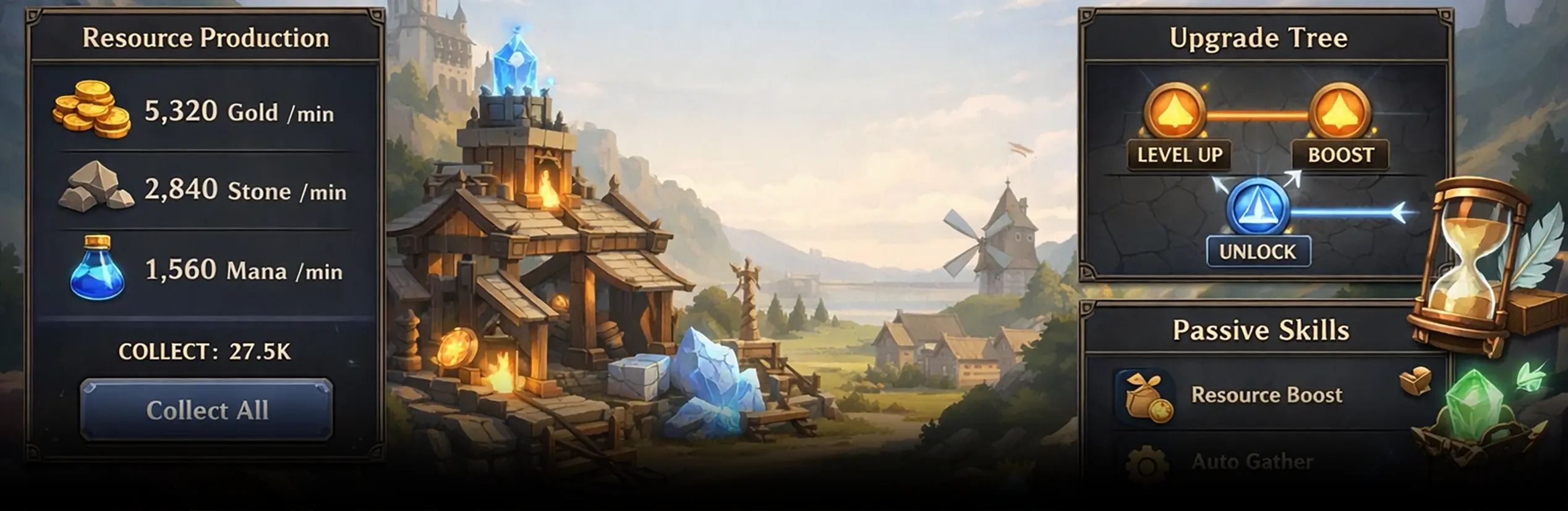

Idle game development is the design and production of games where progress continues while the player is away, driven by a compact tap or upgrade loop that scales through exponential growth, offline earnings, and prestige resets. The category succeeds because sessions are short, the reward schedule is generous, and the systems keep paying out without demanding attention, which suits mobile behaviour and rewarded video monetization better than most genres.
The idle core loop and why it retains
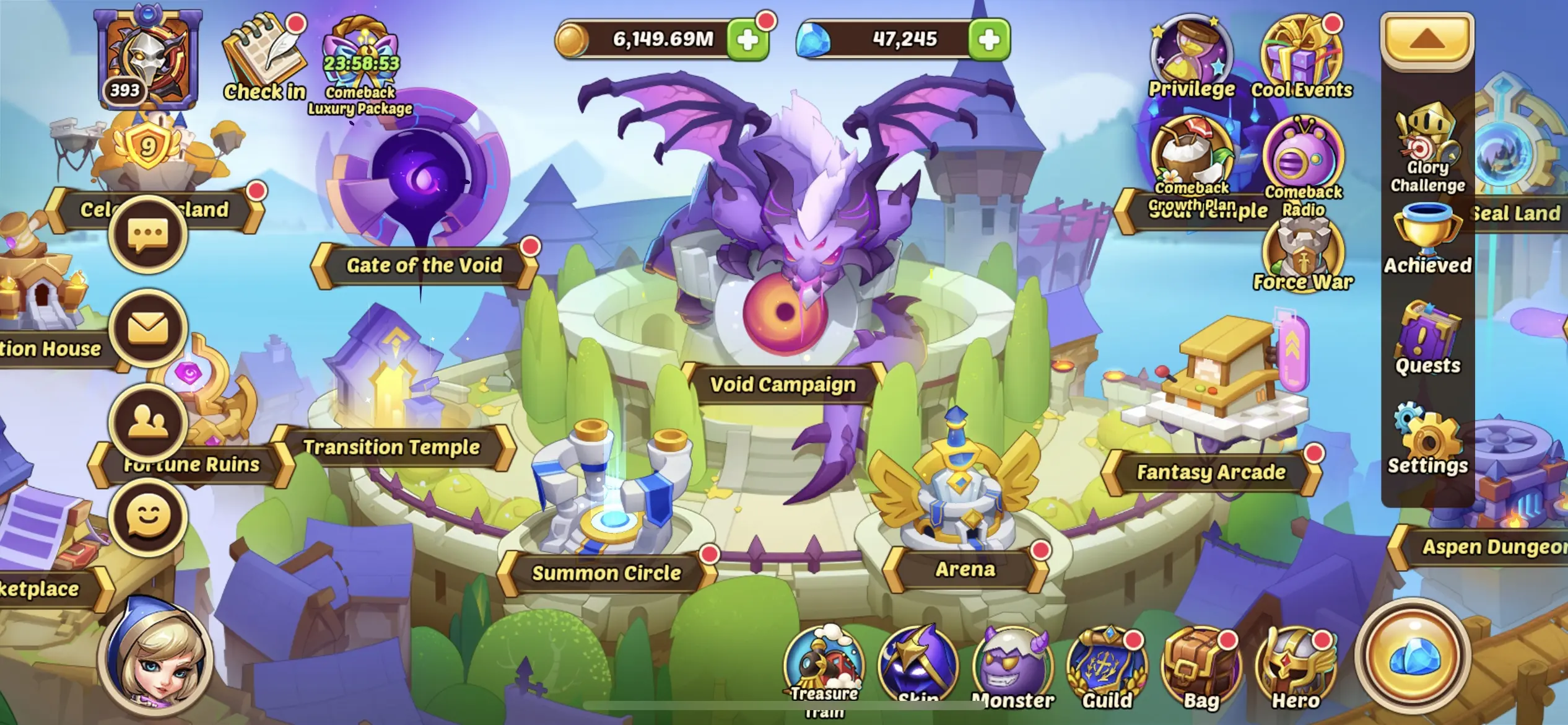
Idle Heroes
The idle core loop is a short cycle of tap, upgrade, unlock, and automate that returns visible reward every few seconds and lets progress continue in the background. A first-time player taps for a few coins, buys a generator, watches it produce automatically, and then spends on multipliers that raise output by orders of magnitude. Within the first minute the game must show numbers going up without input, because that is the promise of the genre. Idle game development treats this loop as the entire product surface, and every other system feeds it.
Retention holds because the loop respects the player's time. A five-second check-in produces a clear gain. A ten-minute session moves the player through several upgrade tiers. A day of absence returns as an offline earnings pop-up that reframes the game as a background companion rather than a demand on attention.
Scoping idle game development or a hyper-casual title with idle elements?
Progression math and exponential curves
Progression in idle titles runs on exponential cost curves, usually with a growth factor between 1.07 and 1.15 per upgrade level. Output scales at a similar or slightly higher rate, so each new tier feels stronger than the last. Designers plan the curve in a spreadsheet before writing code, mapping cost, output, and time-to-next-upgrade for the first 100 to 500 levels, then verify the curve holds under offline accumulation.
A common failure is a curve that flattens too early, which kills the sense of growth around level 30 to 50. Another is a curve that grows so fast the player stalls without a monetization prompt. The math is where the game lives or dies.
Offline earnings and away-time rewards
Offline earnings are the mechanic that turns idle into a background game. When the player returns, the game calculates production accumulated during absence, applies a cap (often 2 to 24 hours), and presents the reward as a modal with a rewarded-video multiplier. The cap protects long-term engagement, because unlimited offline gain would remove the reason to reopen the app after a week away.
Server-authoritative timestamping is standard for anti-cheat, since local device clocks are trivially altered. A small backend endpoint issues signed session tokens and validates elapsed time before crediting production.
Prestige, ascension, and long-term structure
Prestige is the reset mechanic that gives idle games their long tail. After a player reaches a milestone, they trade current progress for a permanent multiplier (often shown as stars, souls, or gems), which accelerates the next run. Well-tuned prestige triggers around a 2x to 4x speedup on the second run, then narrows as the player reaches deeper layers of meta-progression.
Prestige is where idle game development crosses into systems design. Second and third meta-layers, artifact trees, and seasonal challenges keep long-term players in the loop for months or years without new content dropping every week.
Monetization: IAP and rewarded video
Idle monetization runs on two rails: rewarded video ads and in-app purchase. Rewarded video is the workhorse. Players watch a 15 to 30 second ad in exchange for a 2x offline boost, a 30-minute production doubler, or a chest of soft currency. Fill rates and eCPMs are strong in the category because sessions are short and ad slots feel earned rather than intrusive.
IAP is layered on top: a starter pack in the first session, a no-ads offer once ad frequency is felt, a subscription for permanent boosts, and event-driven bundles tied to prestige milestones. Idle titles that publish ARPDAU benchmarks in the Deconstructor of Fun idle game breakdowns usually sit in the $0.05 to $0.25 range, with the upper band driven by strong LiveOps rather than a bigger install base.
Retention benchmarks and reward pacing
Healthy idle titles land around 35 to 45 percent Day 1 retention, 15 to 20 percent Day 7, and 5 to 10 percent Day 30 on soft-launched builds. Reward pacing drives those numbers more than art or narrative. The first session should deliver three prestige-worthy "aha" moments: a first automation, a first big multiplier, and a first offline check-in.
Beyond Day 7, retention becomes a LiveOps problem. Static idle games plateau. The ones that grow ship weekly events and seasonal resets.
LiveOps for idle titles
LiveOps in idle game development is a small, tight loop of events, offers, and balance tweaks that ship every one to two weeks. A typical calendar includes a weekend prestige event, a mid-week timed bundle, and a monthly seasonal artifact drop. The team behind a live idle title is usually 4 to 8 people: a producer, a live designer, one or two engineers, an artist, a data analyst, and QA on rotation.
Remote config is essential. Cost curves, drop rates, offline caps, and IAP prices should all be tunable from a dashboard without a client build. Firebase Remote Config, Unity Cloud Content Delivery, or a custom feature-flag service each work depending on scale.
Tech stack: Unity, Cocos, and HTML5
Unity is the default engine for idle game development on mobile. Its C# runtime, mature ad SDKs, and cross-platform build pipeline cover most production needs. Addressables handle content delivery for seasonal events. IL2CPP builds keep the runtime performant on low-end Android devices, which matter because idle titles skew toward emerging markets. See Unity game development for the wider engineering stack.
Cocos2d-x is a lighter alternative when the game is 2D-only and the studio wants a smaller binary. HTML5 with PixiJS or Phaser is the pick for instant-play channels such as web portals and messenger platforms, where a 5 MB budget beats a 100 MB APK. See game porting for teams moving an existing idle title to a lighter web-first client. The Unity mobile ads documentation is the current reference for ad mediation and is worth reading in full before scoping ad revenue.
Idle subgenre comparison
Idle, incremental, clicker, and merge overlap in mechanics but differ in what the player actually does. Scoping decisions depend on which subgenre the studio is targeting.
| Subgenre | Core input | Progression driver | Session length | Typical reference |
|---|---|---|---|---|
| Idle | Passive + occasional tap | Offline earnings, automation | 1-5 min | AdVenture Capitalist, Egg Inc. |
| Incremental | Frequent tap + upgrade | Exponential unlock tree | 5-15 min | Melvor Idle, Trimps |
| Clicker | Rapid tap | Per-tap output scaling | 2-10 min | Cookie Clicker, Tap Titans 2 |
| Merge | Drag and combine | Combinatorial upgrades | 5-20 min | Merge Dragons, Merge Mansion |
When to talk to Game-Ace about idle game development
Talk to Game-Ace when the concept is validated on paper and the studio needs a production team to build the core loop, tune the progression math, integrate ad SDKs, and prepare the soft launch. A first playable typically lands in 6 to 10 weeks, with a soft-launch build in 4 to 6 months depending on art scope. Game-Ace works as a custom game development studio with full-cycle delivery, co-development, and team extension from a 120+ specialist team. See our deeper piece on hyper-casual game mechanics for the tap-driven design side of this scope.
 How MetaHuman changes game character development
  Game development for startups: budget and MVP guide
  Engineering tower defense games from prototype to live service
  Gamification in recruitment: what actually works
  AI recruitment games: from real-time assessments to better hires