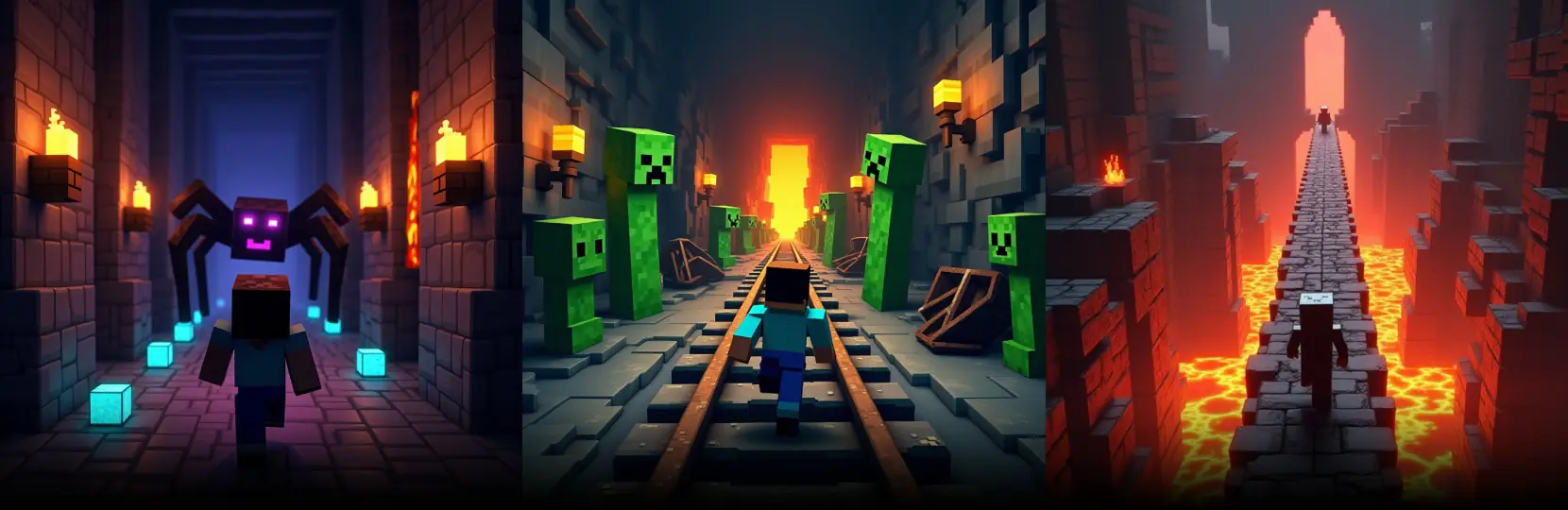

Minecraft runner Roblox development means building a block-styled endless or level-based runner inside Roblox Studio, using Luau for gameplay logic, procedural or hand-authored path generation, and Robux-based monetization. The subgenre is popular because it blends the recognizable voxel look with fast session loops that Roblox's discovery algorithm rewards, and because it ships across mobile, desktop, and console clients from a single build.
Roblox platform basics for an outsourced dev team
An outsourced team stepping into Roblox needs to accept a fixed technical envelope. All code runs in Luau on Roblox's servers and clients, all assets live in Workspace or ReplicatedStorage, all builds ship through Roblox's own CDN, and there is no external store submission for the core client. That constraint speeds delivery but removes options a Unity or Unreal team is used to. A Minecraft runner Roblox development scope has to fit within these platform rules from the first sprint.
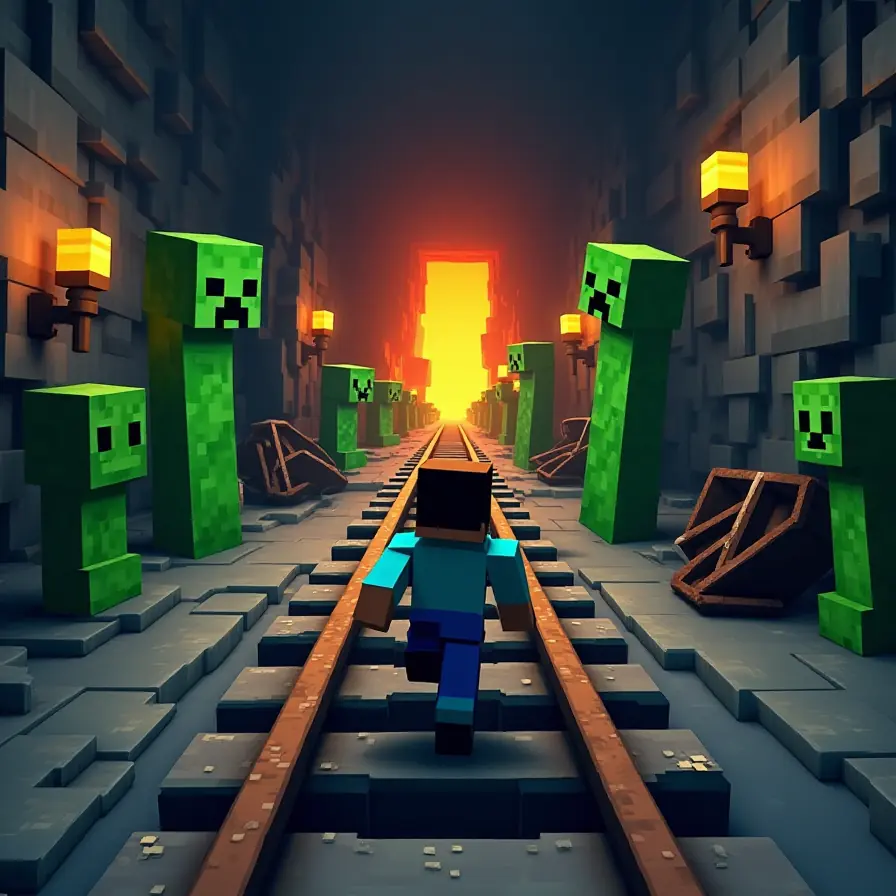
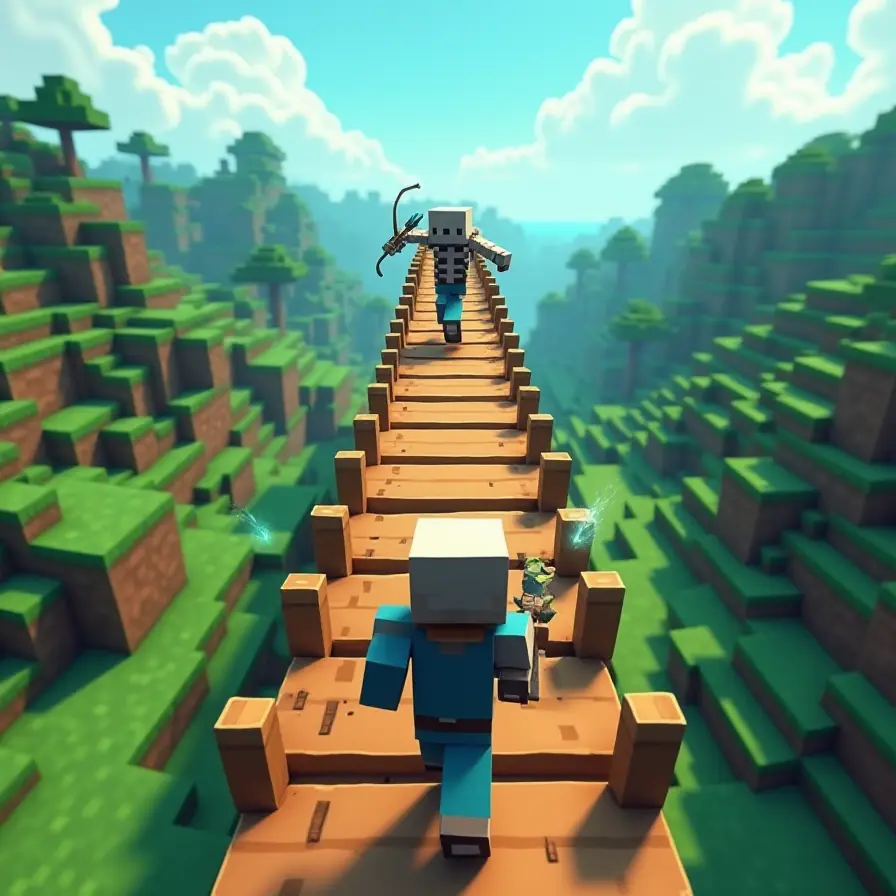
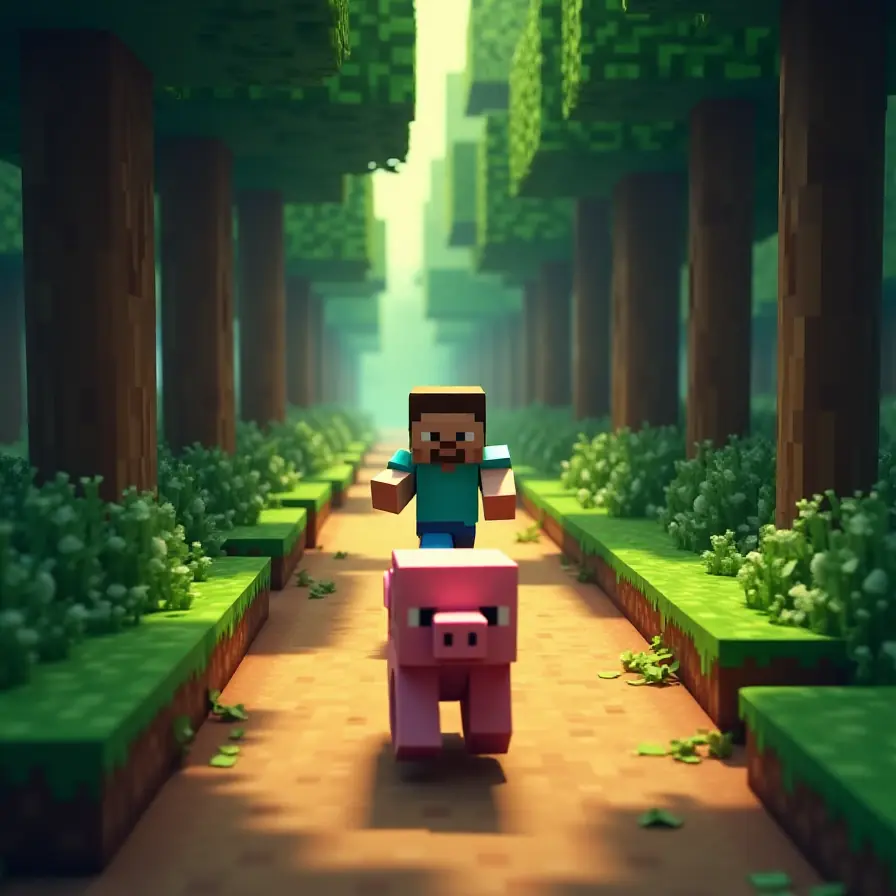
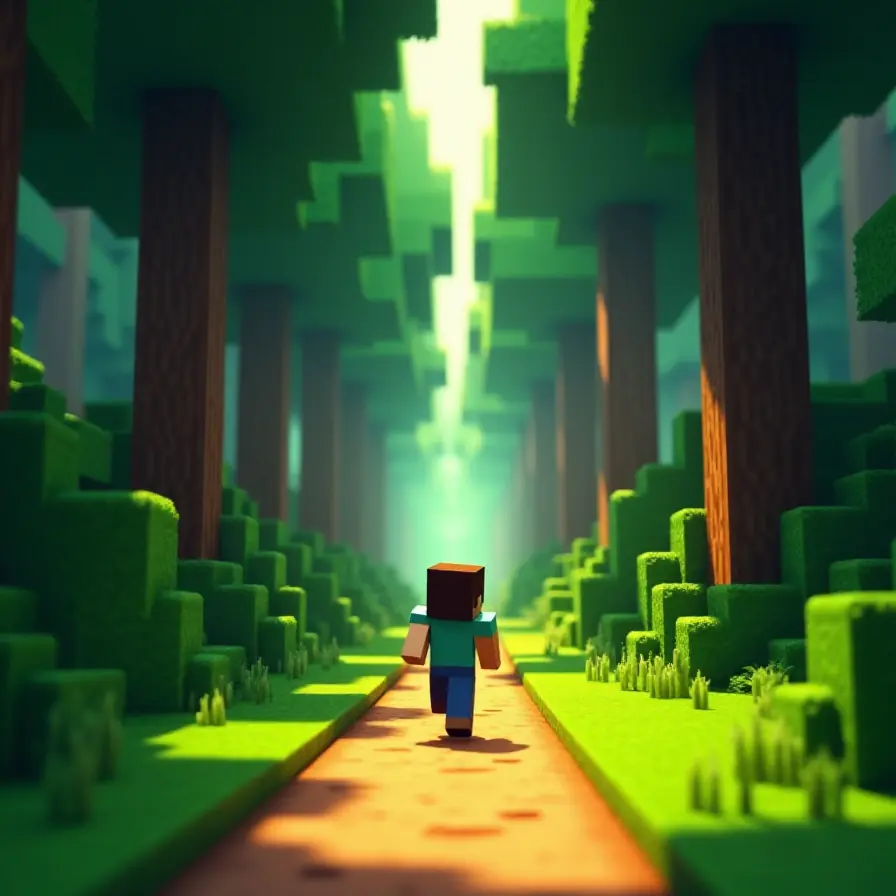
Practical setup for a co-development or full-cycle engagement is straightforward. Source is versioned outside Roblox Studio through Rojo or a similar tool, so gameplay scripts, module scripts, and place files stay in a normal Git repository. The Roblox place itself acts as the runtime target and the staging environment.
The team splits into client, server, and content roles early: client scripts handle input and camera, server scripts own path spawning and scoring, and builders own voxel assets, textures, and UI. See official patterns in the Roblox Creator Docs.
Scoping a Minecraft-style runner or another Roblox build?
Voxel and block-style rendering on Roblox
Roblox Studio was not designed as a voxel engine, so a Minecraft runner Roblox development team recreates the block look with standard Parts and MeshParts. Grid-aligned Parts at one-stud increments read as blocks to the player, and PBR textures with a low-detail material give the surface the flat, matte feel players associate with Minecraft. This approach keeps the build inside Roblox's rendering budget on mobile clients.
There are two hard limits worth planning around: the per-place Part count that starts to hurt streaming performance past roughly 100,000 rendered Parts on mid-range mobile, and the material library, which is fixed. Custom shaders are not available. Teams work within that by baking texture variation into MeshParts and using SurfaceAppearance for higher-fidelity blocks where needed.
Runner mechanics: path, obstacles, collectibles, checkpoints
Core runner loop in Roblox is the same as on any platform. A forward-scrolling path spawns ahead of the avatar, obstacles interrupt the run, collectibles reward attention, and checkpoints or difficulty tiers give the run structure. On Roblox the loop is usually server-authoritative for scoring and cosmetics unlocks, with client-side prediction for local movement to keep input feel responsive.
- Path segments as prefabs stored in ReplicatedStorage, spawned in front of the avatar and cleaned up behind.
- Obstacle types kept short: static block walls, moving blocks, gaps, and hazard tiles cover most designs.
- Collectibles as parts with Touched events, tracked server-side to avoid client exploits.
- Checkpoints as scored gates that write to leaderstats and trigger short reward feedback.
Luau scripting patterns for a Roblox runner
Luau is Roblox's typed dialect of Lua. Since the 2023 typed update, teams can write strict type annotations on module scripts, which catches most refactor bugs before a build reaches QA. For a Minecraft runner Roblox development scope, the standard split is: one Segment module that describes a path piece, one Spawner service that owns the queue, one Player controller that reads input, and one Score service that owns the run state.
Team habits that pay off: keep server and client modules in separate folders, use ModuleScripts over Scripts wherever possible, and avoid deep event chains that hide execution order.
Procedural generation using Region3 and terrain
For a runner, procedural generation usually means chaining pre-authored segments rather than voxel-by-voxel synthesis. The Spawner picks a segment based on the current difficulty tier, clones it from ReplicatedStorage, positions it at the next spawn anchor, and releases the previous segment once the avatar has passed. Region3 is used to define spawn and cleanup zones, and to detect when a segment is fully behind the player.
Terrain-based paths are an option when the design calls for organic hills or caves between block corridors. Roblox's terrain API supports voxel-scale editing at runtime, so a runner can carve short terrain sections around each segment for variety. Terrain generation is heavier than Part streaming, so the team caps it per session.
Avatar movement and jump feel
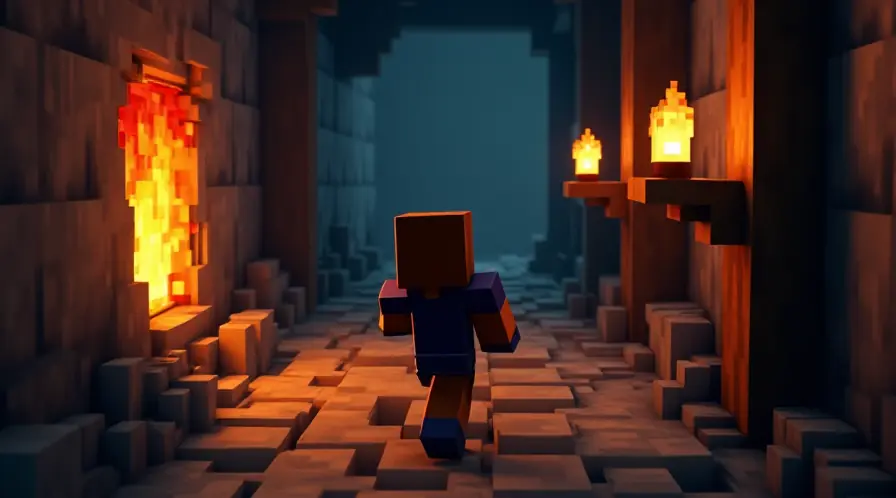
Movement feel is where most Roblox runners are won or lost. Default Humanoid values give a floaty jump that reads wrong for a Minecraft runner Roblox development target, where players expect a snappy, arcade-like arc. Teams tune JumpPower, WalkSpeed, and gravity together, and often use BodyVelocity or LinearVelocity for lane-swap movement rather than raw Humanoid steering.
Input parity across mobile touch, gamepad, and keyboard is planned from the start. Roblox handles most of it automatically, but swipe gestures for lane switch and jump need explicit tuning to avoid false triggers on smaller screens.
Monetization on Roblox: Robux, developer products, game passes, Premium payouts
Roblox monetization sits on four primitives. Robux is the platform currency players buy. Developer products are consumable purchases inside a game, usually a currency top-up or a revive. Game passes are one-time purchases that grant a permanent effect, like a cosmetic or a boost. Premium payouts pay a share of Roblox Premium subscriber engagement time back to the developer.
For a Minecraft runner Roblox development target, the workable stack is a mid-priced revive as a developer product, two or three cosmetic game passes, a soft-currency shop backed by developer products, and Premium payouts as a background revenue line. Aggressive monetization is punished by the community and by Roblox's discovery signals, so pricing is kept conservative. See Roblox monetization for the deeper mechanics.
Analytics and A/B testing
Roblox's built-in analytics dashboard covers session length, DAU, MAU, retention curves, and monetization funnels. For deeper A/B tests, teams add a lightweight remote config on the server that flips gameplay or price variants per user cohort, records the cohort in the analytics event, and reads results back through the dashboard or a custom BigQuery export.
Common experiments on a runner: first-obstacle difficulty, revive price, cosmetic drop rate, tutorial length. Each experiment runs for at least one weekend cycle to average out day-of-week effects.
DevEx cut and Roblox economy realities
The economic reality of Roblox is that the developer keeps a fraction of the sticker Robux price. After the platform fee and DevEx cashout rate, a Robux earned in-game converts to roughly 0.0035 USD when cashed out through the Developer Exchange, and the developer needs a Premium subscription plus a minimum Robux balance to qualify. This is a floor, not a ceiling, and teams model revenue against it from the first pitch.
A studio scoping a Minecraft runner Roblox development project needs to plan around this. A game with strong retention but weak monetization can still under-deliver on cash, and a scope that assumes iOS App Store margins will land short. Roblox's advantage is discovery volume, not per-user ARPU. See the Roblox DevForum monetization category for community pricing benchmarks.
Cost and timeline
A focused Minecraft runner Roblox development scope, built as a first release with a small content set, typically runs 3-5 months and lands in the €40,000-€90,000 range depending on team size and art scope. A live-ops version with weekly content, event system, and expanded monetization moves into 6-9 months and the €100,000-€180,000 range.
Team shape is small: 1 gameplay engineer, 1 Roblox builder or environment artist, 0.5 UI or 2D artist, 0.5 producer, and shared QA. Full-cycle delivery through Game-Ace runs on this shape with an in-house Roblox lead, and co-development runs against a client-side producer or design lead.
QA on Roblox client and mobile
QA on Roblox needs to cover the client matrix Roblox itself supports: iOS, Android, Windows, macOS, and Xbox as a baseline. Meta Quest is optional depending on the scope. The QA plan lists a device matrix that includes at least two mid-range Android phones, one lower-end iPhone, and one desktop, because performance regressions show up first on constrained clients.
Common findings on a runner: touch input dead zones, memory growth from uncleaned path segments, network hitches on segment spawn, and cosmetic z-fighting on block seams. QA runs against a private test place, and passes are gated on a bug-count threshold and a frame-time budget on the slowest device.
Roblox runner subgenre variants
Not every Minecraft-styled Roblox game is a pure runner. The table compares three common variants a team may be asked to scope.
| Variant | Core mechanics | Monetization fit | Dev complexity |
|---|---|---|---|
| Pure runner | Auto-run, lane switch, jump, collectibles, checkpoints | Revives, cosmetic passes, currency top-ups | Low to mid |
| Runner-obby hybrid | Runner base plus obstacle-course sections with manual pacing | Skip passes, checkpoint unlocks, cosmetics | Mid |
| Voxel adventure runner | Runner path plus explorable side rooms, light crafting or collectibles meta | Currency top-ups, expansion passes, event passes | Mid to high |
When to talk to Game-Ace about Minecraft runner Roblox development
Game-Ace works on Roblox scopes as full-cycle delivery, co-development, or team extension, with in-house Roblox builders, Luau engineers, and mobile-experienced QA. If a Roblox runner is on the roadmap, Game-Ace, a custom game development studio, can scope the build against realistic Robux economics and a device matrix that reflects the platform's real audience. Related work sits on Roblox game development and mobile game development, with engagement models covered on the game co-development page.
 Roblox monetization: strategies that actually earn
  Roblox trends in gaming: what is working now
  Hire Roblox developers: where to find and how to scope
  12 Roblox game ideas that actually work
  Roblox gamified education: a play-to-learn design guide