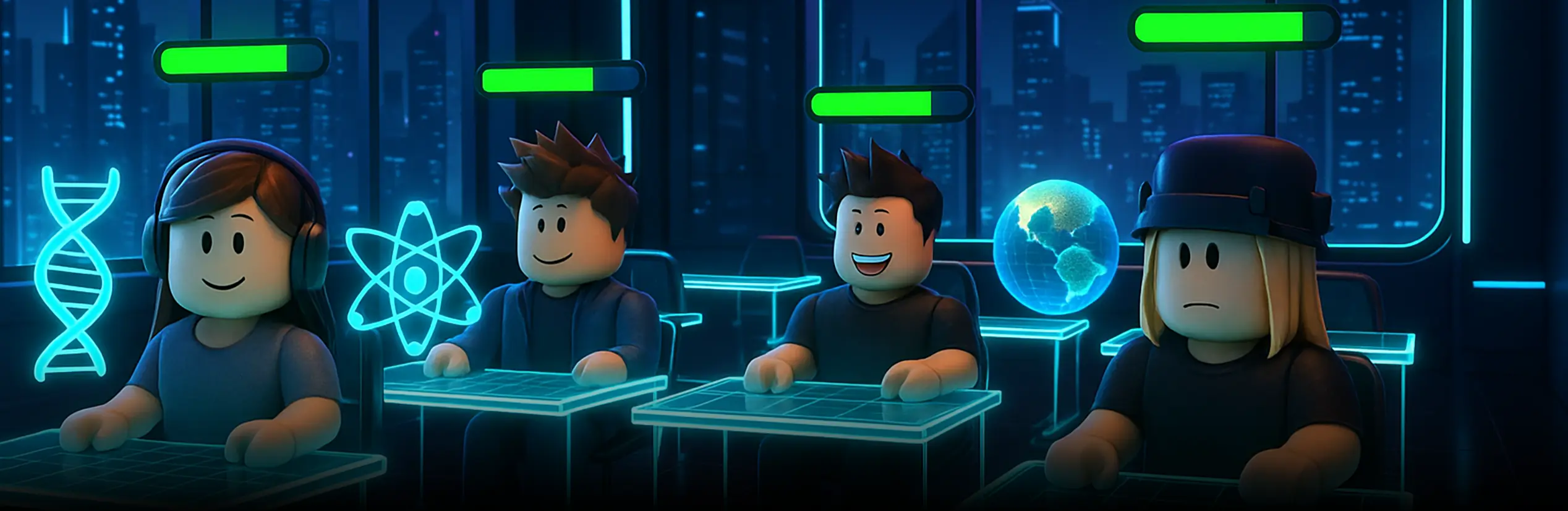

Roblox gamified education means using Roblox Studio, Luau scripting, and the platform's built-in social and progression systems to deliver play-to-learn experiences with measurable outcomes. Teams treat lessons as loops of goal, action, feedback, and reward. The result is a hosted learning experience that runs across mobile, desktop, Xbox, and VR, with analytics captured by default.
Why the play-to-learn methodology matters for Roblox projects
Roblox gamified education fails when a team ships a set of quests without a learning objective mapped to each mechanic. It works when every level, badge, and score value reinforces a specific concept the learner should acquire. This pattern matches wider research on game-based learning outcomes and applies across Roblox and non-Roblox platforms.
That is the difference between a Roblox mini-game and a play-to-learn experience. A methodology forces the design to answer three questions before scripting starts: what does the learner need to do differently after the session, which mechanic produces that behavior change, and how will the system detect that the change happened. Most successful Roblox education builds follow a lesson design brief before a single Luau script is written. The brief lists the target skill, the observable behavior, the mechanic used, and the data captured per session. Roblox Studio then becomes the execution layer, not the design source. Roblox's official education resources at Roblox Education publish curriculum templates that follow this pattern, and comparable practice patterns are covered in our note on gamification in education.
Scoping a Roblox learning experience or corporate onboarding gamification?
Five gamified education approaches on Roblox, compared
Not every play-to-learn Roblox experience uses the same design pattern. Five approaches recur across school, brand, and corporate L&D briefs. Each has different mechanics, best-fit age range, and assessment characteristics. Teams that want a broader catalog of format types can consult our Roblox educational games formats guide, which pairs with this methodology piece.
| Approach | Mechanics used | Target learner age | Assessment fit |
|---|---|---|---|
| Classroom quest | Guided story missions, NPC dialogue, checkpoint quizzes | 8 to 13 | Formative; per-checkpoint answer capture |
| Mastery-learning loop | Level unlocks, retry-on-fail, XP with skill tags | 9 to 16 | Criterion-referenced; unlock gates prove mastery |
| Narrative-driven world | Branching dialogue, choice consequences, discovery zones | 10 to 17 | Reflective; log decisions, review with facilitator |
| Simulation and role play | Job roles, task lists, timed procedures, team objectives | 12 to adult | Performance-based; scored on procedure accuracy |
| Competitive leaderboard | Ranked matches, seasonal ladders, badge tiers | 10 to adult | Norm-referenced; useful for engagement, weaker for depth |
Choosing between them is a scoping decision, not a preference. Corporate onboarding rarely benefits from a competitive leaderboard because ranked play penalises new hires. A K-6 alphabet build cannot use branching narrative because reading load exceeds the target age. Match the approach to the learner and the outcome before Studio work starts.
Core Roblox mechanics that actually teach
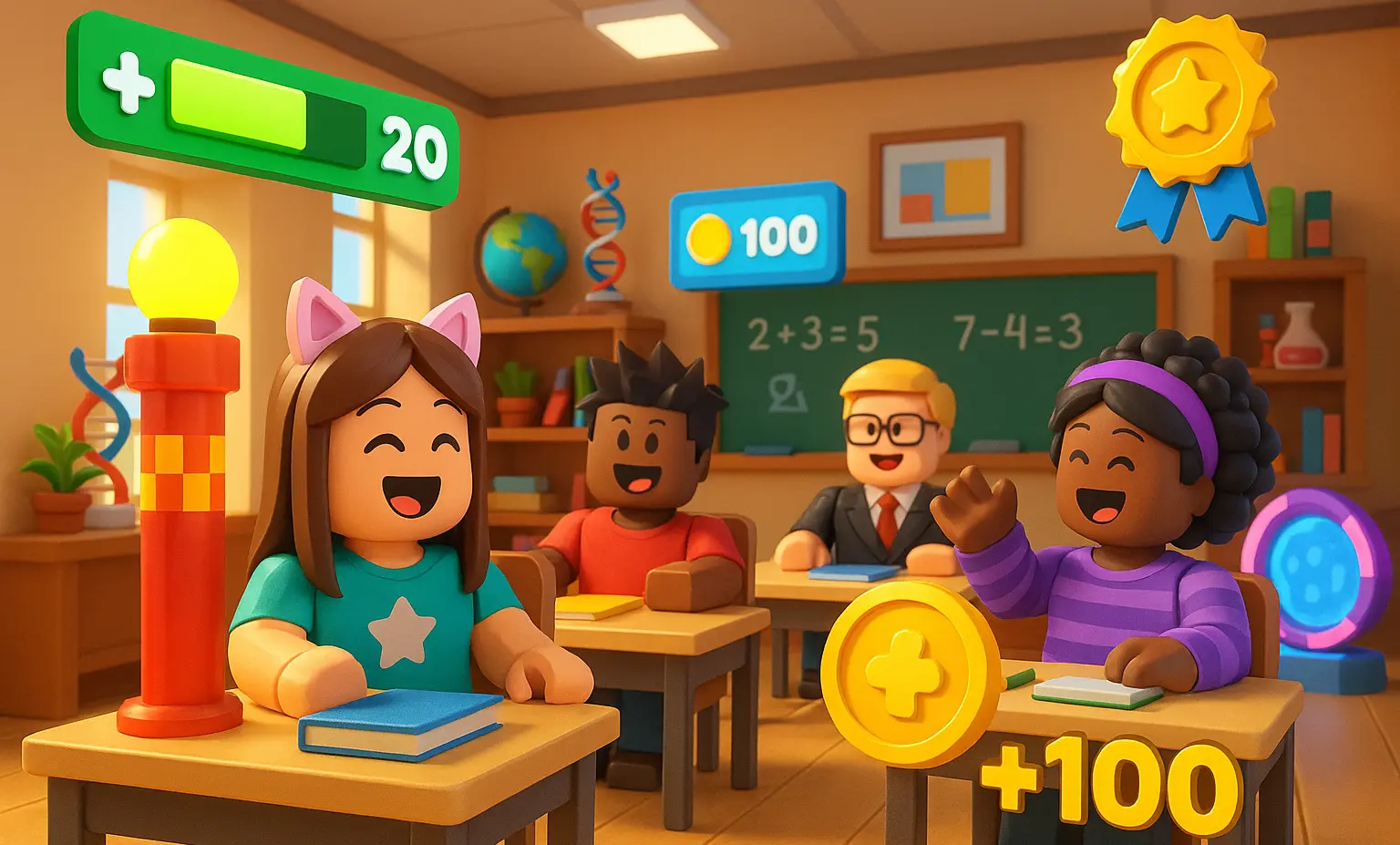
The mechanics that move learning forward on Roblox are the ones that produce feedback fast enough for the learner to link cause and effect. Delayed feedback breaks the loop.
Roblox Studio and Luau support the whole set out of the box, without custom backend. XP with skill tags lets one score represent progress in different sub-skills, not a single total. DataStore keeps state between sessions so learners resume where they stopped, which matters for classroom periods split over days. MessagingService coordinates events across server instances for classroom cohorts. RemoteEvents drive immediate scripted responses to actions, which is how you turn a wrong answer into a scaffolded hint rather than a dead end. TeleportService partitions cohorts, so a 30-learner class runs on one shard while other users stay isolated for privacy.
- XP with skill tags for granular progress tracking, not a single cumulative score.
- DataStore for cross-session persistence so learners resume at the correct step.
- MessagingService for cohort-level events, such as a synchronous quiz start.
- RemoteEvents for immediate scripted feedback on action, not delayed report cards.
- Badges for milestone recognition tied to demonstrated skill, not participation.
- TeleportService for private classroom shards separated from public servers.
How progress is measured inside a Roblox play-to-learn experience
Assessment inside Roblox gamified education is the part that most briefs treat last and pay for the most in rework. Design assessment before mechanics.
Three assessment layers cover most learning contexts. Formative capture records answers, choices, and retries during the session, and feeds them back to the learner immediately. Criterion-referenced gating locks the next level until the learner clears a threshold on the current one, which enforces mastery-learning without a proctor. Longitudinal telemetry stores completion timelines, retry counts, and skill-tag improvement across sessions in DataStore or an external analytics endpoint. For classroom deployments, an out-of-game dashboard reads that data through a REST bridge and lets the teacher see per-learner and per-skill status. Alignment with a curriculum standard like Common Core State Standards is a scoping input, since it defines the skill tags used inside the game.
COPPA, GDPR-K, and district compliance for Roblox gamified education
Any Roblox play-to-learn experience aimed at under-13 learners in the U.S. is subject to COPPA. Roblox platform handles the account layer, but the experience developer is responsible for what the experience collects, how it stores personal information, and what it sends to third parties. The safe pattern is to capture only pseudonymous learning telemetry keyed to a Roblox userId, store it inside DataStore, and avoid piping any user-identifying data to external analytics.
For school district deployment, procurement teams usually require a data protection addendum, a privacy impact assessment, and a review of any external services the experience calls. GDPR-K applies for EU learners and requires parental consent handling. Chat, user-generated content, and any social interaction must be either disabled or tightly moderated in an education build. Roblox's education licence tier and private-server options are designed for that use, and the Trust and Safety controls should be locked before publishing. Similar controls apply to non-Roblox builds we deliver under educational games for kids and serious game development scopes.
Corporate L&D and onboarding use cases for Roblox gamified education
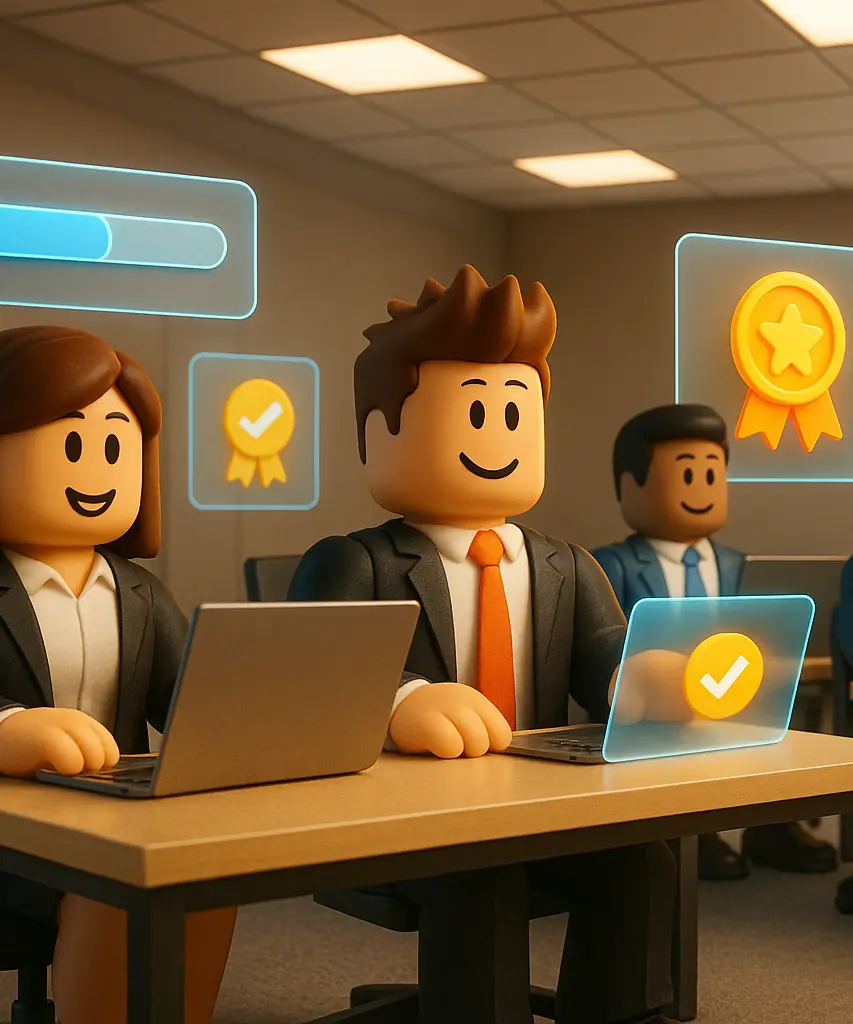
Corporate learning teams have started to use Roblox not for public marketing but as an internal training environment for early-career hires who already play on the platform.
The use cases that survive procurement review are the ones where interaction density matters more than production fidelity. Safety drills, retail scenario training, first-day-of-work simulations, and cyber-hygiene training all fit. The value comes from letting the learner make a mistake in a low-stakes environment and see the consequence within seconds. That loop is difficult to build in a slide deck or a video course. On Roblox, a private experience runs across mobile, desktop, and Meta Quest, so employees join from the device they already have. The build itself is closer to a scripted scenario than to a full production Roblox game, so timelines are shorter and budgets more predictable. Team Extension and Co-development engagement models let internal L&D teams keep design authorship and use external Roblox specialists for Luau scripting and Studio build. Game-Ace's gamification services team handles this scope for enterprise onboarding briefs.
What a Roblox gamified education build looks like in delivery
The build breaks into six stages regardless of approach. Each stage has a clear artifact so the client sees progress and can course-correct before Studio work locks in.
- Lesson design brief listing target skills, observable behaviors, mechanics, and telemetry per behavior.
- Curriculum or L&D framework alignment, including skill-tag taxonomy.
- Level and mechanic prototypes inside Roblox Studio, tested with target-age users.
- Assessment layer, DataStore schema, and dashboard or export path for facilitators.
- Compliance pass covering COPPA, GDPR-K where relevant, Trust and Safety controls, and district data handling.
- Publish, monitor, and iterate with real usage data from the first cohort.
Timelines depend on scope. A single mastery-learning module aimed at one skill tag typically runs six to ten weeks. A curriculum-mapped classroom experience covering a semester's worth of activities is usually four to seven months. Corporate onboarding modules with two or three scenarios and a facilitator dashboard fall in the middle.
When to talk to Game-Ace about Roblox gamified education
If your team is scoping a Roblox play-to-learn experience for a school district, an EdTech publisher, a brand awareness campaign, or corporate L&D, Game-Ace's custom game development studio provides methodology-led delivery. Engagement models include Full-cycle, Co-development, and Team Extension. Scope covers lesson design brief, Roblox Studio and Luau build, DataStore-based assessment layer, COPPA and Trust-and-Safety pass, and post-launch iteration with real cohort data.
 Roblox monetization: strategies that actually earn
  Roblox trends in gaming: what is working now
  Hire Roblox developers: where to find and how to scope
  12 Roblox game ideas that actually work
  Roblox browser game: how to play Roblox in a browser