
Serious games are interactive experiences built with game mechanics for a non-entertainment goal: workforce training, formal education, healthcare rehabilitation, defense readiness, employee onboarding, safety compliance, and customer education. Unlike consumer titles, serious games measure learning outcomes, integrate with an LMS, and deliver reportable performance data. They combine instructional design, gameplay systems, and analytics standards such as xAPI to prove skill acquisition.
What serious games are and where they are used
A serious game is a purpose-built interactive product that uses gameplay to teach a specific skill, procedure, or behavior. The primary success metric is measurable learning, not entertainment revenue. Buyers include L&D departments, universities, hospital systems, defense ministries, insurance carriers, industrial operators, and public agencies. Common use cases include compliance training, sales enablement, clinical procedure practice, equipment operation, soft-skills simulation, K-12 STEM, and rehabilitation after injury.
The category overlaps with simulation and edutainment but is distinct. A "serious game" always ties gameplay to a documented learning objective, tracks the learner's actions, and returns data that instructors or auditors can act on.
- Corporate training: onboarding, sales, leadership, safety, compliance.
- Healthcare: surgical practice, patient rehabilitation, therapy adherence.
- Defense: tactical decision-making, procedural training, mission rehearsal.
- Education: K-12, higher-ed labs, adult upskilling.
- Government and NGO: public health messaging, civic education, disaster response.
Scoping a training simulator, an educational title, or a VR readiness program?
Learning theory behind serious games

Effective serious games are built on established learning theory, not on gameplay borrowed from consumer titles. Instructional designers usually map objectives to Bloom's revised taxonomy, then align mechanics to the level of cognition required. A recall objective can use a quiz mechanic; an application objective needs a scenario with branching consequences; an analysis or evaluation objective needs an open-ended simulation with feedback. Retrieval practice, spaced repetition, and formative feedback are the standard scaffolding.
Motivation is engineered separately. Self-determination theory (autonomy, competence, relatedness) informs the reward loop; a well-tuned serious game keeps the learner in a challenge band close to their current skill so the flow state can form.
Instructional design and serious games production
Production usually starts with a learning needs analysis run by the client's L&D team or a consulting instructional designer. Objectives, target audience, delivery constraints (browser, mobile, VR headset, kiosk), and assessment strategy are locked before any gameplay design work. The GDD then translates each learning objective into a gameplay verb, a scoring rule, and a feedback moment. This is the point where most projects succeed or fail: if the mechanic does not require the target skill, the learner does not practice it.
A typical serious game moves through discovery, GDD, prototype, content pass, integration, QA, pilot, and post-launch iteration. Game-Ace runs this pipeline as full-cycle production or co-development with the client's in-house L&D and IT teams. The pilot phase is important: instructional effectiveness is measured with a small learner cohort before scale rollout, and both content and mechanics are adjusted based on the data.
- Discovery: learning objectives, audience, delivery targets, LMS environment.
- GDD: mechanics mapped to objectives, scoring, feedback, replay logic.
- Prototype: playable slice used to validate the core learning loop.
- Content and art: modules, scenarios, characters, environments, voice-over.
- Integration: LMS/LRS wiring, SSO, xAPI or SCORM statements.
- QA: content correctness, accessibility, device matrix, LMS reporting.
- Pilot and iterate: cohort data, revision, then full rollout.
VR and AR for training and serious games
VR is now a practical delivery channel for high-consequence training: surgical procedures, industrial maintenance, aviation, hazardous-environment response, and soft-skills scenarios where the learner rehearses a conversation with a virtual person. Standalone headsets (Meta Quest 3, Pico 4, Apple Vision Pro for enterprise pilots) removed the tethered-PC cost barrier and made distributed rollouts realistic. AR is used for on-the-job assistance and equipment training in the learner's real workspace. Teams scoping this delivery channel can review our VR game development service.
A VR serious game is not a straight port of a desktop module. Interaction, locomotion, session length, and comfort settings all have to be redesigned; assessment logic that worked on a mouse-and-keyboard interface needs a new capture surface for hand and gaze input.
Analytics, xAPI, and LMS integration
Reportable learning data is what separates a "serious game" from a game about a serious topic. The industry standard for granular event data is xAPI (the Experience Application Programming Interface), maintained by the ADL Initiative. Every meaningful learner action, a completed scenario, a decision at a branch, a hint used, a time spent in a specific state, becomes an xAPI statement and lands in a Learning Record Store (LRS). SCORM is still used where the LMS only accepts SCORM packages, but xAPI is the direction of travel.
Integration usually means single sign-on with the client's identity provider, launch from the LMS, statement emission during play, and completion or score reporting back to the LMS gradebook. Standards work here is coordinated by the IEEE Learning Technology Standards Committee.
Measuring serious games effectiveness
Measurement design has to be part of the GDD, not an afterthought. The common frame is the Kirkpatrick model: reaction (did the learner enjoy it), learning (did knowledge or skill change), behavior (is behavior different on the job), and results (is a business KPI moving). Serious games can capture the first two through in-game telemetry; behavior and results usually require a follow-up study with the client's operations team.
A pre-test / post-test with a control group is still the strongest evidence a serious game produces the intended learning gain. Where a formal study is not possible, in-game performance curves against a defined mastery threshold give a defensible proxy.
ROI of serious games for enterprise buyers
ROI is calculated against the current training baseline: instructor-led time, travel cost, error rate on the job, safety incidents, time-to-productivity for new hires, or customer support call volume. A serious game replaces or reduces one of those cost lines. For a distributed workforce, the removed travel and instructor time alone often clear the payback bar within the first year.
For regulated environments, the ROI conversation also includes audit defensibility. xAPI statements and LMS records give a per-learner activity trail that manual training does not.
Tech stack and team for serious games
Unity remains the most common engine for serious games because of its cross-platform reach (WebGL, iOS, Android, Windows, macOS, Meta Quest, Pico) and its mature C# tooling. Unreal Engine 5 is used where photorealism matters, for example medical, industrial, or defense simulations. Web-only distribution can use HTML5 with PixiJS or PlayCanvas for lighter scenarios. Studios scoping the Unity path can review our Unity game development service.
A typical Game-Ace serious game team includes a producer, a game designer with instructional-design familiarity, engineers, 2D or 3D artists, a QA lead, and an integration engineer for LMS and xAPI work. Team sizes range from 3 to 12 for a scoped module and scale up for platform builds. Delivery follows Team Extension, Co-development, or Full-cycle development, with strict NDA and full IP transfer.
Serious games vs edutainment vs simulation vs gamification
Buyers often confuse four adjacent categories. This table separates them by primary goal, format, and delivery context.
| Attribute | Serious game | Edutainment | Gamification |
|---|---|---|---|
| Primary goal | Measurable skill or behavior change | Awareness or interest | Motivation of an existing task |
| Format | Full interactive game or simulation | Short interactive content or activity | Points, badges, leaderboards on a non-game workflow |
| Assessment | Structured, xAPI or SCORM reportable | Light or none | Task-completion metrics |
| Typical buyer | L&D, healthcare, defense, education | Publishers, museums, K-12 | HR, sales ops, product teams |
Simulation sits close to the serious-games category: a training simulation with scoring, learning objectives, and reportable outcomes is effectively a serious game with a simulation front-end.
Related reading
- Gamification in education: how game mechanics can support learning and engagement.
- How game-based learning drives real results: practical outcomes of game-based learning.
Serious games work in the Game-Ace portfolio
One shipped project illustrates the studio's serious games work: cybersecurity training.
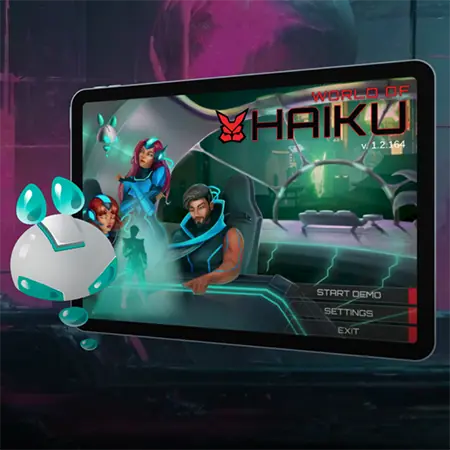
Welcome to Haiku, a cybersecurity training game by Game-Ace

Haiku is a serious game built in Unity that teaches online security through interactive scenarios instead of courseware. Game-Ace joined as a UI/UX partner, rebuilding the interface, optimising load-scene performance, and adding a state-saving feature so learners resume exactly where they left off.
When to talk to Game-Ace about serious games
A serious games project usually starts as a training or learning problem, not as a game brief. Game-Ace fits when the client has a defined learning objective, an audience, a delivery constraint, and either an LMS to integrate with or a plan to stand one up. The Game-Ace custom game development studio has delivered 200+ games since 2005 with a 120+ specialist in-house team, covering full-cycle production, co-development, and team extension under strict NDA with full IP transfer.
 How MetaHuman changes game character development
  Game development for startups: budget and MVP guide
  Engineering tower defense games from prototype to live service
  Idle game development: a full production guide
  Gamification in recruitment: what actually works