
Gamification in education means adding game mechanics such as XP, quests, badges, streaks, and leaderboards to non-game learning activities. Applied well in K-12, higher ed, and EdTech products, gamification in education improves engagement and short-term retention, with mixed but generally positive effects on learning outcomes when the design is grounded in self-determination theory rather than pure reward loops.
Definition: gamification vs game-based learning
Gamification in education layers game elements on top of existing content. The lesson stays a lesson; XP, badges, and streaks track progress. Game-based learning goes further: the lesson is the game, and knowledge is acquired by playing. Serious games are standalone titles built for a defined learning objective, while edutainment prioritises entertainment with educational themes.
The distinction matters for scoping. A gamification in education layer inside an LMS is a lightweight feature build. A game-based learning module is a full production. Confusing the two leads to underscoped budgets and disappointed stakeholders.
Scoping a gamification layer, a learning game, or a full EdTech product?
Gamification vs game-based learning vs serious games vs edutainment
| Approach | Core idea | Typical scope | Example |
|---|---|---|---|
| Gamification | Game mechanics on non-game content | LMS feature layer, EdTech add-on | Duolingo streaks, Khan Academy badges |
| Game-based learning | Learning happens through gameplay | Standalone learning game or module | Prodigy Math, Dragonbox |
| Serious games | Game built for a specific learning goal | Full production, often bespoke | Foldit, medical training sims |
| Edutainment | Entertainment with educational themes | Consumer app or channel | Khan Academy Kids, Wonderbox |
Self-determination theory as the design frame
The strongest research base for gamification in education is self-determination theory. Learners engage when three needs are met: autonomy, competence, and relatedness. Points and badges alone cover competence weakly and often crowd out intrinsic motivation. Effective EdTech products design for all three: learner choice, visible progress, and social presence.
Age-appropriate design for K-12 and higher ed
Age drives every design decision. K-2 needs large touch targets, voice prompts, and reward loops tied to short sessions. Grades 3-5 respond to avatars, quests, and collaborative mechanics. Middle school introduces mastery paths and social leaderboards, used carefully to avoid demotivating lower performers. High school and higher ed lean on autonomy, portfolio-style progress, and integration with real assessments.
For K-12 products, COPPA and GDPR-K constraints shape the entire architecture: no behavioural advertising, no third-party trackers without verifiable consent, and strict data minimisation. Higher-ed products face fewer child-privacy constraints but heavier LMS interoperability requirements (LTI 1.3, SCORM, xAPI).
EdTech product patterns that work
The category leaders in gamification in education share a small set of patterns. Duolingo uses daily streaks, XP, hearts, and league-based social pressure to drive habit. Kahoot! runs short competitive quizzes with music and countdowns for classroom energy. Prodigy Math wraps standards-aligned math into an RPG world with battles gated by problem-solving. Khan Academy uses badges and energy points as low-pressure progress markers on top of mastery learning.
- Streaks and daily habit loops (Duolingo, Dragonbox).
- Short-session competitive quizzes (Kahoot!, Blooket).
- Standards-aligned RPG progression (Prodigy Math).
- Mastery badges and energy points (Khan Academy).
- Sandbox creation for classrooms (Minecraft Education, Roblox Studio for Education).
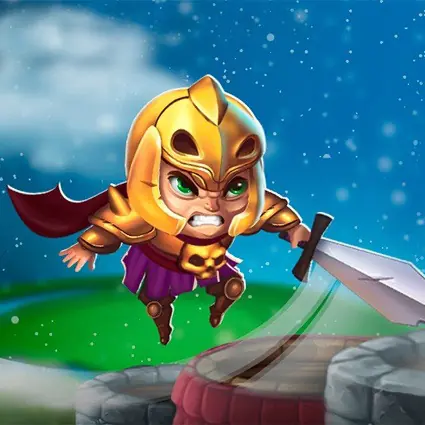
Don’t Mess With Texas — an educational game by Program-Ace
Core mechanics: XP, quests, badges, streaks, leaderboards
Mechanics are tools, not goals. Each carries a design cost.
- XP and levels: cheap to implement, easy to overuse; anchor to real skill progression, not activity counts.
- Quests: strong for structuring long content into achievable chunks; require narrative and pacing work.
- Badges: work as recognition when tied to specific competencies; noise when awarded for everything.
- Streaks: powerful habit driver; punishing for younger learners and neurodivergent users without freeze mechanics.
- Leaderboards: motivate top performers, demotivate the middle; safer as small cohort or class-level leaderboards.
- Avatars and customisation: strong autonomy signal; low cost when built on a modular art system.
Risks: extrinsic vs intrinsic motivation
The core risk of gamification in education is well-documented in the research. Heavy extrinsic rewards can displace intrinsic interest in the subject. A student who studies for badges may stop when the badges stop. Meta-analyses (Sailer, Homner, and others) show positive short-term effects on engagement but smaller and more variable effects on long-term learning.
Design mitigation is straightforward but often skipped: tie rewards to meaningful mastery, give learners control over goals, and avoid punishing loss (broken streaks, public rank drops) for younger users.
Accessibility and inclusivity
Accessibility is a first-class requirement for education products, not a late-stage QA pass. WCAG 2.2 AA is the baseline for schools and public procurement. Practical implications for gamified interfaces:
- Colour is never the only signal for state (correct, incorrect, active).
- All animations respect the prefers-reduced-motion setting.
- Streak and timer mechanics have alternative pacing modes for neurodivergent learners.
- Screen reader support for game HUD elements, XP counters, and badge unlocks.
- Captioning and sign-language options for narrated content in K-12 products.
- Keyboard-only navigation for every interaction, including drag-and-drop puzzles.
Measurement: learning gains vs engagement metrics
Engagement metrics are easy: DAU, session length, streak length, quest completion. Learning gains are harder. A serious measurement layer for gamification in education tracks pre- and post-assessment scores, transfer to unfamiliar problems, and retention at 2-week and 8-week intervals. xAPI statements let a learning product feed a Learning Record Store, so administrators can correlate in-product behaviour with real outcomes.
Production pipeline for EdTech games
An EdTech product build follows the same production spine as any game: discovery, GDD, prototype, vertical slice, production, QA, launch, live ops. What differs is the parallel curriculum track. A learning designer or subject-matter expert works alongside the game designer from day one, mapping standards (Common Core, national curricula) to mechanics and levels. Assessment items are authored, reviewed, and calibrated in parallel with content.
Game-Ace runs EdTech projects with a joint discovery phase covering learning objectives, target age band, platform mix, LMS integration needs, and compliance profile (COPPA, GDPR-K, WCAG 2.2 AA). Unity is the default engine for cross-platform K-12 and higher-ed products; web-first classroom tools ship as WebGL or as pure HTML5 when device targets include Chromebooks and low-spec tablets.
Cost and timeline
A gamification layer on top of an existing LMS or content platform typically runs 3-5 months and starts around €40,000-€90,000, depending on the mechanics set and analytics scope. A standalone game-based learning module (single subject, single grade band, web and mobile) usually falls in the €120,000-€350,000 range across 6-10 months. Full EdTech products with multi-year curriculum coverage, backend, and live ops are annual programs, sized by scope and platform mix.
An educational game Game-Ace has delivered
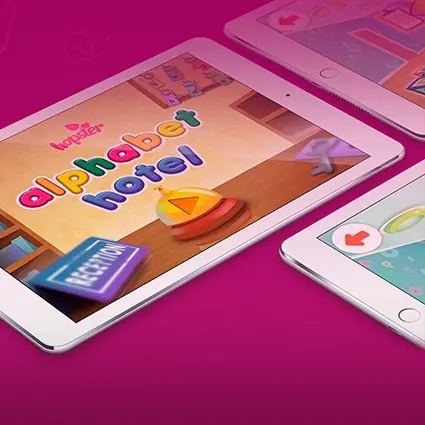
Hopster's Alphabet Hotel — official trailer
Welcome to Hopster's Alphabet Hotel, a preschool learning game by Game-Ace
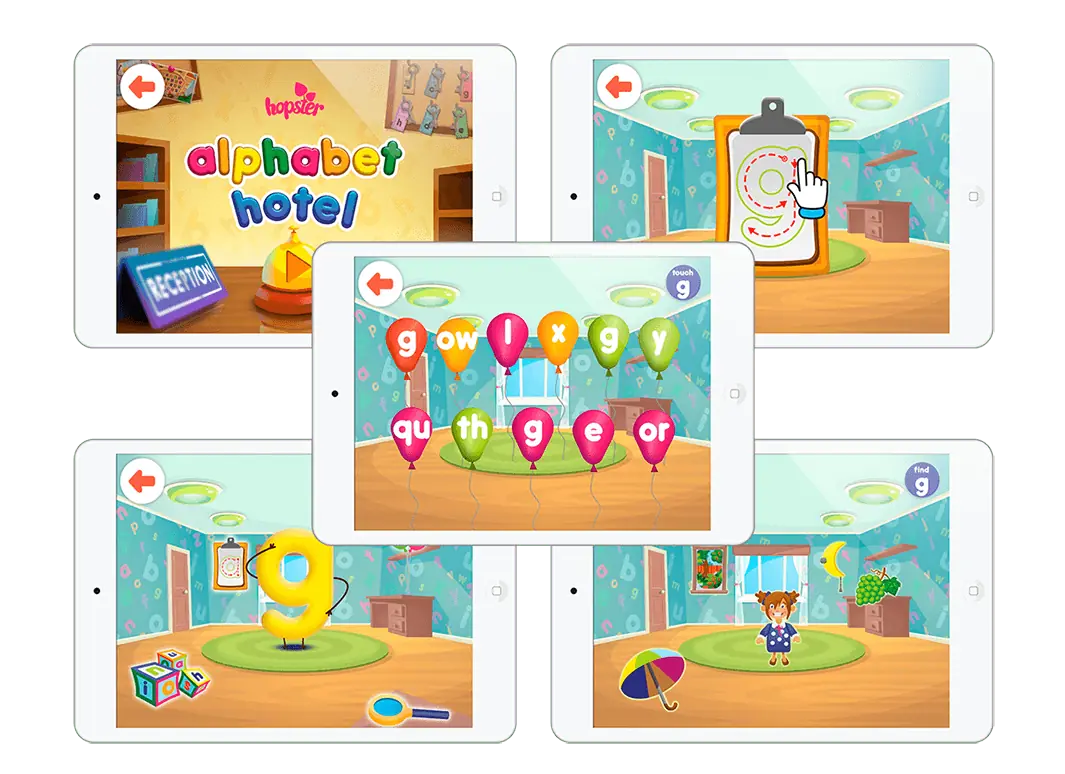
Hopster's Alphabet Hotel is an interactive game that helps toddlers learn the alphabet through 26 letter-themed mini-games and character-led storytelling. Game-Ace handled art, animation, and full production for iOS and Android, tuned for touch-first interactions and short-session play typical of early learners.
When to talk to Game-Ace about gamification in education
Game-Ace has built educational and gamified products for publishers and studios since 2005, with 120+ in-house specialists covering game design, engineering, art, animation, and QA. For teams planning a gamification in education product, Game-Ace, a custom game development studio, works across educational games for kids, gamification services, and full-cycle game development engagements. Related reading: serious games for learning and skill development.
External references: Duolingo Research publishes ongoing evidence on habit formation and streak mechanics in language learning. RAND Education covers broader EdTech effectiveness studies useful for procurement decisions.
 How MetaHuman changes game character development
  Game development for startups: budget and MVP guide
  Engineering tower defense games from prototype to live service
  Idle game development: a full production guide
  Gamification in recruitment: what actually works