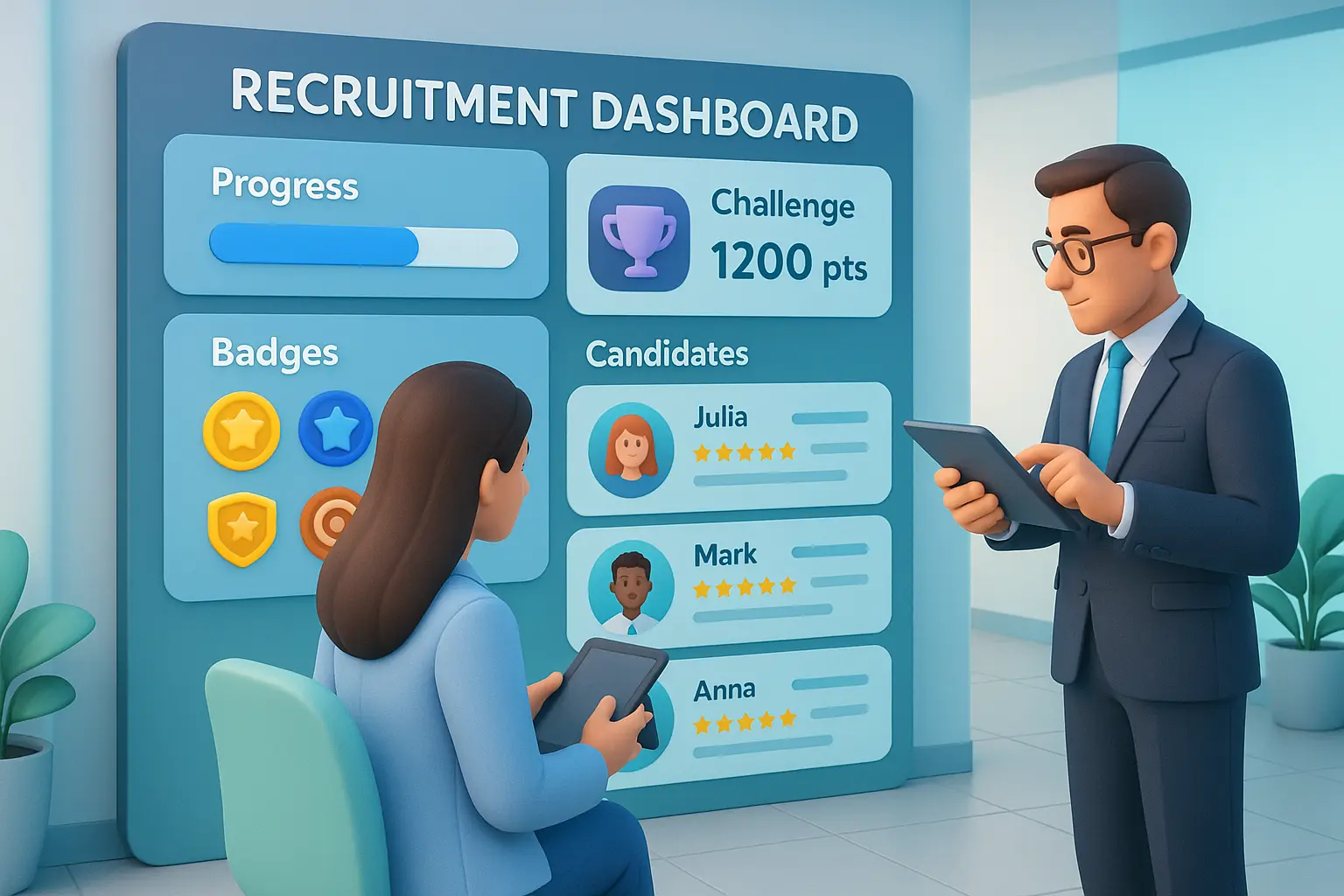

Gamification has moved far beyond simple quizzes or badges, and our team sees a clear shift in how companies now apply it to recruitment. Hiring teams use gamification to measure skills, reduce bias, and speed up decision-making because standard interviews no longer provide sufficient, reliable data.
Candidates expect fair evaluation, instant feedback, and tasks that reflect real work. Recruiters expect accurate insights and faster screening. We see both sides push the market toward more structured, transparent, and measurable hiring flows powered by gamification.
Many HR directors now rely on data from short skill-based games to understand how applicants think, solve problems, and react under pressure. Your organization can use similar tools to compare candidates on equal terms and reduce subjective judgments. Our specialists also notice that gamification gives candidates a clear reason to stay engaged during multi-step hiring processes, especially in competitive job markets.
Recruitment in 2026 demands motivation, clarity, and precision. Gamification supports all three when designed with real tasks, smart scoring systems, and clear instructions. Your team gains stronger insights, and applicants get a process that feels fair and worth their time.
The New Talent Landscape and Why Use Gamification in Recruitment
Candidate behavior changed sharply over the past few years, and recruiters now deal with applicants who expect clarity, feedback, and fair evaluation from every hiring step. Many HR teams turn to gamification to achieve that level of structure without slowing down the process.
Our specialists often see stronger results when recruiters replace long tests with short, skill-focused scenarios because applicants stay active longer and produce more reliable data. One insight also comes from how rapidly gamification in education has normalized interactive evaluation, so younger candidates now expect similar methods in hiring. Recruiters who adopt gamification gain faster screening, higher engagement, and better signals about problem-solving ability and communication style.
How Shifting Candidate Expectations Influence Gamified Screening
Candidate expectations are now shaped by digital services that offer clarity, speed, and the freedom to complete tasks on any device. Recruiters feel pressure to match that standard, especially when applicants judge a company's professionalism by the quality of its hiring process.
Gamified screening meets those expectations when tasks are short, relevant, and easy to understand. Many organizations follow the structure used by top gamification companies, since their formats rely on real scenarios instead of theoretical exercises.
A stronger design often includes several layers:
- Purpose clarity. Applicants understand why each task matters.
- Skill alignment. Tasks measure only the skills required for the role.
- Structured scoring. Recruiters receive data they can trust.
- Fair repetition. Everyone receives the same tasks with identical rules.
Recruiters get actionable data, and applicants move through each stage with less frustration and more confidence in the outcome.
Why Use Gamification in Recruitment to Address Engagement Drops
Engagement drops often start when applicants face slow, unclear, or repetitive steps. Many organizations address that problem by adding gamified tasks that keep candidates engaged throughout the entire funnel.
Short scenarios deliver progress feedback, and applicants feel that their time is respected. Our team sees fewer withdrawals when tasks resemble real work because people understand the purpose behind each action.
A well-structured flow usually contains:
- Clear entry. Applicants know how long each step takes.
- Focused challenge. Every task measures a specific ability.
- Instant result. Recruiters and applicants receive outcomes without delays.
- Meaningful progress. Each subsequent step feels connected to the previous one.
Strong engagement often translates into higher-quality data and more completed assessments.
Market Forces That Accelerate Gamification Adoption
Recruiters face more pressure each year to identify strong candidates quickly, and many no longer trust long-form assessments for early screening. Gamification aligns with the pace of current hiring cycles because short, skill-focused tasks provide teams with reliable data without slowing them down.
Many organizations already use games for business in training, so expanding the method to recruitment feels natural and familiar to their workforce. Hiring teams appreciate how game-based tasks reveal real behavior rather than surface-level answers.
Several forces now push adoption forward:
- Volume growth. Larger applicant pools demand automated early filtering.
- Skill precision. Recruiters want direct evidence of problem-solving, focus, and adaptability.
- Process clarity. Short challenges reduce confusion and set clear expectations.
- Competitive pressure. Faster decisions help organizations respond to talent shortages.
HR teams that adopt gamification report clearer insights earlier in the process, while candidates experience a flow that feels more transparent and worth their effort. Many organizations now shift toward assessment formats that feel modern, measurable, and aligned with real job requirements, and gamification offers a direct path in that direction.
Find out how we can improve your recruitment
Skill-Based Assessments Reinvented Through Gamification in Recruiting
Recruiters rely more on talent signals that reflect real performance, not self-reported strengths. Gamification supports that shift by turning assessments into short, practical tasks that mirror actual responsibilities. Many teams prefer this format because it highlights problem-solving, accuracy, and focus under pressure.
Candidates also respond better when they understand how their actions translate into results. Our specialists see far better data quality when employers use structured, scenario-based tasks rather than traditional quizzes. Gamification reshapes how teams verify ability, and companies gain a clearer picture of how applicants behave in real conditions.
How Gamified Skill Tests Provide More Predictive Insights
Predictive hiring depends on observable behavior, and gamified assessments offer exactly that. Recruiters gain access to reaction patterns, decision quality, and task-specific performance, allowing them to compare candidates on equal terms.
Many organizations prefer game-based formats because they produce consistent data that does not rely on subjective interpretation. Applicants also tend to complete more stages when the tasks feel purposeful.
Several qualities make gamified tests more predictive:
- High task relevance. Challenges reflect the role's real conditions.
- Standardized scoring. Every applicant receives the same measurement logic.
- Reduced bias. Objective task data limits the influence of guesswork or intuition.
- Behavior signals. Recruiters see problem-solving speed, accuracy, and adaptability.
Clearer data helps hiring teams predict success in training and in day-to-day work. Candidates gain a fair method that evaluates effort, not background or interview confidence.
Recruiters using gamified tests often identify strong performers earlier, which shortens decision cycles and improves long-term retention because the selected applicants better match practical job demands.
Gamification Examples in Recruitment for Technical and Cognitive Roles
Technical and cognitive roles require accuracy, structured thinking, and steady performance under pressure, and gamification helps recruiters verify those qualities quickly.
Short scenario-based tasks give organizations insight into how applicants write code, debug logic, analyze patterns, or process information at speed. Many teams prefer this format because candidates demonstrate real skills instead of describing them.
Common formats include:
- Logic challenges. Tasks that test reasoning quality and analytical structure.
- Technical mini-projects. Small coding or system-design tasks completed under time limits.
- Pattern recognition tests. Quick assessments for memory, focus, and data interpretation.
- Problem-solving routes. Multi-step sequences that reveal how applicants break down complex tasks.
Recruiters analyzing those results can quickly see who maintains accuracy, works through obstacles, or understands core principles required for the job. Candidates also appreciate formats that mirror actual responsibilities, as they feel more confident that the process evaluates them fairly.
Many companies use gamification examples in recruitment like these to reduce hiring risks and select applicants who are prepared for real workloads from the start.
How to Use Gamification in Immersive First-Round Screening
Early screening becomes far more accurate when applicants interact with short, immersive tasks that reveal how they think and behave under pressure. Recruiters gain clear signals about problem-solving ability without relying on long questionnaires. Many teams adopt this approach because applicants stay motivated when tasks feel engaging and purposeful.
One influence also comes from how common gamification in learning has become, which makes applicants more comfortable with interactive formats. First-round screening benefits from tasks that show real behavior, shorten decision time, and give both sides a sharper view of skill fit.
Real-Time Problem-Solving Simulations for Early Filtering
Recruiters often need a fast way to see how applicants react under pressure. Real-time simulations solve that challenge by presenting short problem chains that expose decision quality and focus. A small introductory step is enough, while most of the insight comes from structured scenario elements.
A strong simulation usually includes:
- Dynamic triggers. Sudden changes in available data, shifting priorities, or new obstacles that force applicants to adjust without hesitation.
- Time windows. Fixed response periods reveal how well someone balances accuracy with speed when the clock is running.
- Clear outcome paths. Actions that produce immediate and visible results, allowing recruiters to understand how each decision influences the final state.
- Diverse task elements. Logical puzzles, coordination tasks, attention checks, or short communication prompts that together form a broader performance picture.
- Standardized scoring. Rules that transform scenario choices into measurable outputs, making it easy to compare candidates on equal terms.
Recruiters end up with sharper insights in far less time. Strong performers generally show consistency across all challenge elements, which often correlates with faster onboarding and fewer early-stage training hurdles.
Why Interactive Scenarios Improve Candidate Understanding of the Role
Applicants gain a more realistic view of a job when they interact with tasks similar to those they will face later. Short intro paragraphs usually cannot offer much clarity, so most of the value comes from targeted scenario components that break down role expectations.
Practical scenarios often rely on:
- Practical task previews. Short sequences that mirror essential daily activities, showing candidates the actual type of work rather than a vague description.
- Step-by-step flow. A logical task progression that imitates real workflow, helping applicants understand how responsibilities connect and in which order tasks typically appear.
- Direct feedback loops. On-screen results or summary messages that explain why a choice succeeded or failed, giving candidates a realistic sense of the consequences.
- Workload exposure. Elements that reveal the job's pace, complexity, and required attention level, reducing the risk of mismatched expectations later.
- Role-specific context. Details tied to tools, processes, or communication patterns that define success inside the team.
Applicants who go through such scenarios usually develop a grounded understanding of the job, which reduces confusion later in the process and increases long-term fit.
The Rise of Mobile-First Gamification in Recruitment
More applicants now complete early hiring steps on their phones, so mobile-first gamification quickly became a practical requirement. Recruiters rely on formats that work well on small screens, load instantly, and demand little setup. Many teams also see higher completion rates once assessments use short interactions instead of long forms.
A mobile-first approach helps organizations reach larger talent pools because candidates can participate from anywhere without special devices. Reliable navigation, clear touch targets, and fast scoring keep the funnel moving and give recruiters dependable information without slowing the process.
Short-Form Gamified Challenges for High-Volume Hiring
High-volume recruiting leaves almost no room for slow or complex assessments. Recruiters get better results when the first step is a brief, focused challenge that reveals key abilities in minutes. Many companies adopt short-form tasks because they create a predictable flow for both applicants and hiring teams.
The main functions usually fall into three groups:
1. Speed-focused elements
- Short action bursts that expose reaction time.
- Clean task flow that avoids unnecessary steps.
2. Precision-focused elements
- One-skill tasks that isolate problem-solving, memory, or attention.
- Stable scoring rules that remove guesswork.
3. Scalability elements
- Mobile-ready layouts for large applicant pools.
- Instant evaluation to keep recruiters from falling behind.
- Lightweight designs that eliminate downloads or device restrictions.
Short tasks help teams cut through volume without lowering standards. Applicants also feel more in control when each action produces immediate progress, which improves completion rates and reduces early abandonment.
Micro-Simulations Used to Identify Soft Skills Quickly
Soft skills rarely surface through written tests, so many hiring teams switched to micro-simulations. A brief scenario can show how a person communicates, reacts, and manages pressure. Recruiters see behavior instead of promises, and candidates gain a clearer sense of what the role expects.
Strong micro-simulations often combine the following clusters:
Situational cues
- Signals that set the tone of the scenario.
- Context elements that hint at workload and pace.
Decision checkpoints
- Branches that reveal judgment quality.
- Options that expose conflict handling and clarity of thought.
Behavior indicators
- Observable reactions to sudden constraints.
- Tone, initiative, and consistency across steps.
Evaluation structure
- Objective scoring is tied to the scenario's goals.
- Short formats that offer insight without exhausting the applicant.
Such scenarios help recruiters confirm whether an applicant's communication style and adaptability match the environment they will join. Candidates also appreciate the transparency because they see the demands of the job before moving deeper into the process.
Story-Driven Hiring Paths and Gamification in Recruitment Examples
Story-driven hiring paths help recruiters understand how candidates think by placing them inside short, role-specific situations. A narrative gives applicants a clearer sense of expectations and reveals how they handle pressure, interpret context, and make choices. Many teams prefer this format because it feels natural and avoids abstract testing.
Applicants follow a sequence of events, react to consequences, and demonstrate behavioral patterns long before interviews. Several gamification examples in recruitment now rely on story arcs, branching decisions, and character-driven tasks to produce richer insights. Recruiters gain more reliable data, and candidates experience a process that feels engaging and fair.
Narrative-Based Assessments That Reveal Behavioral Tendencies
Narrative-based assessments use short stories or role-play tasks to observe how a candidate reacts to realistic situations. Recruiters learn about judgment, values, problem-solving style, and decision-making under pressure long before interviews. Research on gamified and scenario-based assessments suggests that such methods give deeper insight into behavior than traditional tests.
Such assessments often include:
- Scenario presentation. A candidate reads or watches a short scene that reflects real job challenges.
- Decision branching. Based on their choice, the scenario evolves: actions lead to consequences, revealing judgment patterns.
- Behavioral tracking. System logs response time, path chosen, and consistency across similar challenges.
- Soft-skill focus. Communication style, empathy, stress-response, and adaptability become visible through decisions.
- Context realism. Use of role-specific settings increases relevance and accuracy of results.
- Immediate feedback or consequences. Candidate sees results or consequences of decisions, adding situational realism.
Employers using narrative-based assessments often discover behavioral tendencies that interviews or CVs miss. Candidates who demonstrate consistent, rational responses under pressure tend to perform better in real roles. Strong narrative assessments improve both selection quality and fairness because evaluations rely on observable actions rather than self-descriptions.
Story Scenarios That Support Consistent Hiring Decisions
Using structured story scenarios in early recruitment rounds helps standardize evaluation across many applicants. Every candidate experiences the same setup, decisions, and scoring rules.
That reduces subjectivity and ensures fairness. Empirical studies show that gamified assessments deliver reliable data on cognitive and behavioral skills, often outperforming paper-based tests when measuring procedural knowledge and real-time decision skills.
Major strengths of story-driven scenarios include:
- Uniform conditions for all candidates. Everyone faces identical prompts, decisions, and scoring criteria.
- Behavior-based evaluation. Observed choices replace self-reported traits, which reduces bias and improves predictability.
- Scalable filtering. Large batches of applicants can be screened quickly without losing quality.
- Better insight into soft skills. Communication, empathy, resilience, and decision-making become part of measurable outcomes.
- Reduced drop-off rates. Engaging formats encourage candidates to complete assessments instead of abandoning them.
- Clear record-keeping. All responses are logged, allowing comparative review and audit-ready decision data.
Organizations that use story-driven scenarios often see higher consistency in hiring decisions across different recruiters. Candidates who succeed in those scenarios usually match job requirements more closely. Using a common narrative format keeps standards high while giving every applicant an equal opportunity to demonstrate their suitability.
Data-Backed Hiring Decisions: The Benefits of Gamification in Recruitment
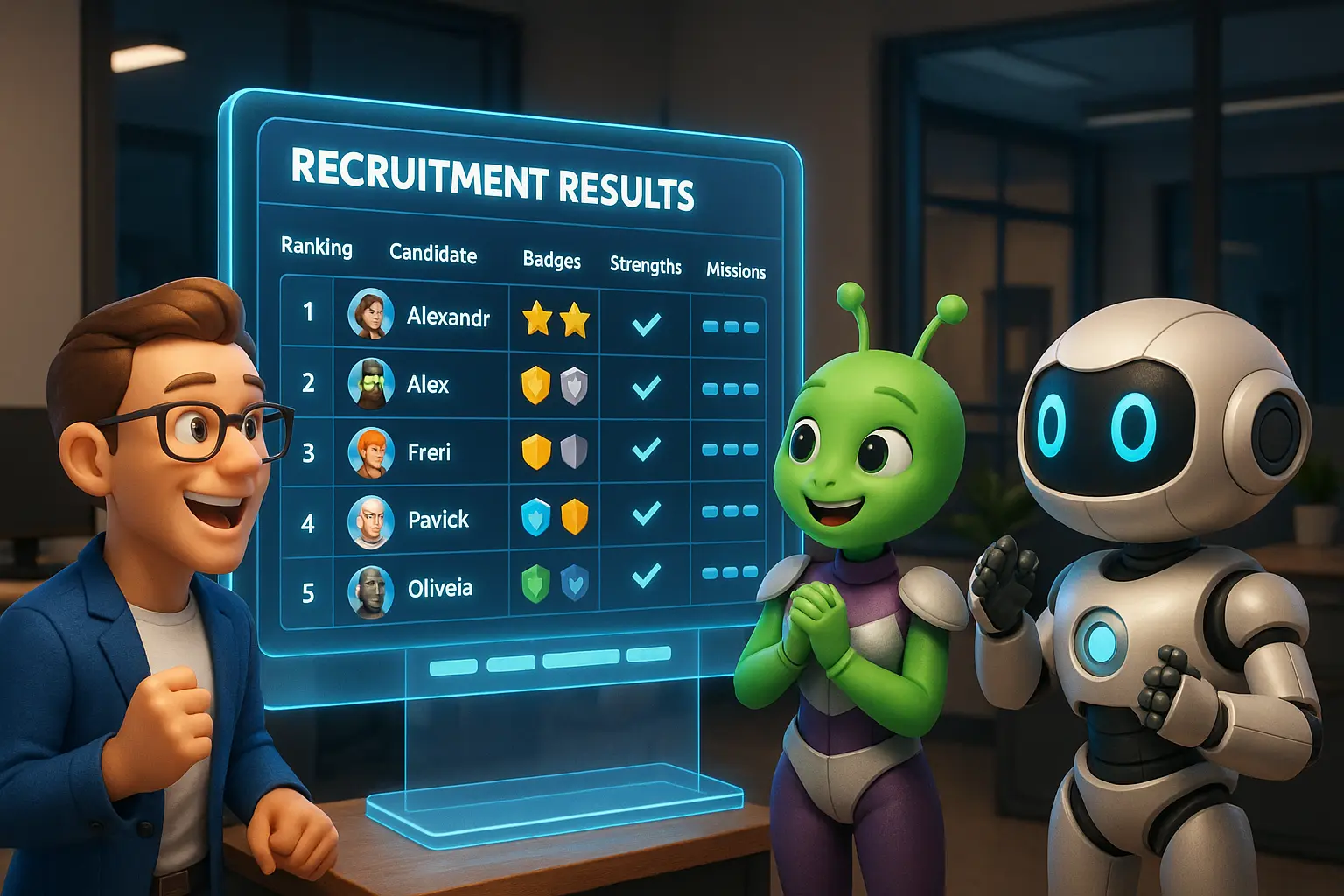
Recruiters rely more on measurable indicators to select candidates, and gamification supports that shift by turning early assessments into structured, trackable events. Each task produces performance signals that replace guesswork with clear evidence. Many teams prefer this approach because scores, completion rates, and behavioral patterns allow side-by-side comparison without subjective interpretation.
Candidates also gain from the process, as the structure clarifies expectations and shows how results are formed. Data-backed hiring gives organizations a repeatable method that improves accuracy and reduces decision time.
Metrics and Analytics Extracted from Gamified Performance
Gamified tasks create a steady stream of data that helps recruiters evaluate candidates with far more precision than traditional tests. Each interaction leaves measurable traces, and those traces form a performance profile that the hiring team can analyze objectively. Instead of relying on impressions, recruiters assess how the applicant behaves under time pressure, shifting information, or task obstacles.
Different categories of metrics often emerge:
1. Task-based indicators
- Completion speed patterns that reveal focus level.
- Accuracy scores are tied to specific challenge types.
- Error frequency under pressure.
2. Behavioral indicators
- Adjustment speed when the scenario changes.
- Consistency across repeated challenge styles.
- Decision paths that highlight judgment quality.
3. Engagement indicators
- Number of attempts completed without reminders.
- Drop-off points inside multi-step tasks.
- Response stability across different devices.
Recruiters reviewing these metrics gain a detailed picture of how candidates think, react, and prioritize. Candidates also benefit because the evaluation is based on visible actions, not interpretation or personal bias.
Benchmarking Candidate Progress Through Standardized Game Tasks
Standardized game tasks allow hiring teams to compare applicants fairly because everyone faces the same rules, scoring, and challenge difficulty. Recruiters rely on these tasks to measure progress during multi-round hiring or track improvement as a candidate moves from one stage to another. Benchmarks help ensure consistency, especially in roles where performance must be predictable.
Several components support accurate benchmarking:
- Identical challenge structure. All candidates interact with the same task framework, which removes variation.
- Clear difficulty tiers. Tasks include defined levels that show how quickly a candidate advances.
- Stable scoring logic. Every attempt uses a fixed formula, ensuring reliable comparisons.
- Repeatable formats. Recruiters can reuse the same task over time to track changes in applicant performance.
- Trend analysis. Patterns in progress reveal learning speed and adaptability.
- Cross-candidate comparison. Results become easy to stack, rank, or cluster without bias.
Such benchmarking gives organizations confidence that hiring decisions rely on equal conditions for all applicants. Candidates also gain a clear view of expectations because each stage builds on a stable, predictable structure.
Adaptive Difficulty and Personalized Candidate Journeys with AI
AI systems now adjust gamified assessments in real time, giving every applicant a path that matches their skill level. Recruiters gain cleaner data because candidates face tasks that neither overwhelm nor under-challenge them. Applicants also feel more confident when difficulty shifts naturally based on their performance.
Adaptive journeys highlight true potential, reduce frustration, and help teams identify promising talent earlier. Companies aiming for accurate, data-backed hiring often rely on AI recruitment games to guide candidates through personalized sequences that reflect how they might perform in real situations.
AI-Driven Difficulty Scaling that Improves Fairness
Difficulty scaling powered by AI helps recruiters evaluate candidates under balanced conditions. One person may require more complex logic steps, while another may need a slower progression to reveal strengths. AI reviews ongoing performance, adjusts task intensity, and keeps every challenge fair regardless of background or prior experience. Recruiters get results that reflect real ability, not familiarity with a specific test style.
Different elements often shape scalable difficulty:
- Performance tracking. Systems assess accuracy, pace, and decision patterns.
- Dynamic adjustment logic. Difficulty moves up or down depending on how well the candidate handles each step.
- Skill alignment. Tasks adapt to the role's core competencies, ensuring relevance.
- Balanced scoring. Scaled difficulty still follows the same evaluation framework.
- Fatigue control. AI avoids steep jumps that pressure candidates unfairly.
- Transparent structure. Clear rules keep candidates aware of progress without revealing scoring algorithms.
Fairness improves once difficulty scaling removes advantages linked to test familiarity. Recruiters receive data that reflects problem-solving ability under adjusted, equitable conditions.
How Dynamic Gamified Paths Reduce Drop-Off Rates
Many applicants leave hiring funnels when tasks feel repetitive, unclear, or mismatched with their skill level. Dynamic gamified paths prevent that decline by shaping the journey around each candidate's pace. AI reviews progress at every checkpoint and selects the most suitable next task, which keeps applicants engaged and reduces unnecessary friction.
Elements that contribute to lower drop-off include:
- Smooth progression flow. Candidates move through tasks that match their capabilities without sudden spikes in difficulty.
- Role-relevant task rotations. Different challenge types keep the experience fresh and aligned with job expectations.
- Clear micro-goals. Small milestones make each stage feel achievable.
- Reduced cognitive overload. AI avoids pushing too many complex tasks in a row.
- Stable task length. Balanced sessions prevent fatigue during early screening.
- Positive pacing. Candidates sense progress, which encourages them to finish the assessment.
Dynamic paths give recruiters more complete assessments, while applicants feel that the process respects their effort and aligns with how they naturally learn and perform.
Compliance, Transparency, and Ethical Gamification in Recruiting
Ethical design plays a central role in modern gamified hiring. Recruiters must provide candidates with tasks that follow clear rules, respect privacy, and avoid unfair advantages. Gamified assessments work best when candidates know what the task measures and how results will be used.
Transparent communication, stable scoring logic, and open guidance help build trust. Ethical gamification ensures that applicants feel respected while recruiters maintain consistent, defensible hiring practices.
Ensuring Fair Play in Gamified Assessments
Fair play depends on predictable rules and an environment where every candidate receives the same opportunities. Recruiters benefit from guidelines that clarify acceptable behavior, allowed tools, time limits, and scoring structure.
Clear explanations reduce confusion and prevent candidates from feeling disadvantaged. Fairness also improves when task design avoids cultural references, idioms, or knowledge that is exclusive to specific groups.
Strong fair-play principles often involve:
- Task neutrality. No cultural or demographic advantages are embedded in the scenario.
- Visible instructions. Rules and expectations should be shown before the assessment begins.
- Controlled timing. Identical limits prevent accidental advantages.
- Consistent task flow. Each candidate follows the same assessment sequence.
- Accessibility support. Options that accommodate different physical or cognitive needs.
- Secure environment. Measures that prevent tampering or outside assistance.
Gamified hiring becomes more reliable once every candidate receives identical conditions and understands precisely how the evaluation process unfolds.
Avoiding Algorithmic Bias Through Transparent Scoring
Algorithmic scoring can strengthen recruitment when designed with openness and strict guardrails. Recruiters must understand how the system evaluates performance, and candidates should know which actions influence their scores.
Transparency limits the risk of hidden biases shaping results. A well-documented scoring process also allows teams to audit decisions, correct errors, and prove that all applicants were measured fairly.
Several elements help reduce algorithmic bias:
- Clear scoring factors. Metrics such as accuracy, pace, and decision patterns are defined upfront.
- Regular audits. Recruiters review aggregate results to detect unusual patterns.
- Role relevance. Only job-critical skills influence the final score.
- Bias testing. Data is checked against demographic variables to ensure equal outcomes.
- Explainable logic. Recruiters can describe why one score exceeds another.
- Fixed thresholds. Identical score requirements apply to all candidates.
Transparent scoring makes gamified hiring both defensible and trustworthy. Recruiters gain confidence in the output, and candidates feel that results reflect their real performance, not automated judgment hidden behind a black box.
Real-World Gamification Examples in Recruitment Across Industries
Recruiters across different sectors now use game-based assessments and interactive hiring tools to screen, engage, and select talent. Some adopt scenarios, puzzles, or role-based tasks to learn how applicants behave under pressure. Others use challenge points, timed tasks, or group-based simulations to see how well people perform in context.
Such techniques make hiring more transparent, measurable, and engaging. Real-world evidence shows gamified recruitment often leads to higher completion rates, broader applicant pools, and clearer behavioral signals, benefits that attract companies across retail, tech, finance, manufacturing, and more. Many educators now explore Roblox play-to-earn gamified education to motivate learners through rewards, structured challenges, and skill-building tasks that feel both engaging and practical.
How Retail, Tech, and Finance Use Gamified Pre-Employment Tests
Many retail, tech, and finance employers adopt gamification to evaluate applicants' cognitive and behavioral traits before interviews. Research shows gamified selection methods improve applicant experience, perceived fairness, and organizational attractiveness compared with traditional selection.
Typical use cases in these sectors include:
- Logical reasoning and reaction-time tasks. Short challenges test decision speed, problem-solving, and stress handling under time limits.
- Situational judgment games. Candidates respond to realistic scenarios. For example, a customer request in retail, data entry under time pressure in finance, or debugging logic in tech.
- Cognitive-skill assessments via game mechanics. Spatial, verbal, or pattern-recognition challenges help evaluate abilities required for tech or finance positions.
Scientific reviews note that gamified assessments often outperform traditional methods at measuring procedural knowledge and cognitive skills relevant to many roles. Employers benefit by filtering large applicant pools efficiently while obtaining more reliable data on applicants' potential and adaptability under realistic task conditions.
Logistics, Manufacturing, and Healthcare Examples That Improve Efficiency
Industries with hands-on tasks or high procedural demand sometimes use gamified simulations to test operational or soft skills before hiring. Academic studies of gamified job design in manufacturing demonstrate measurable improvements in motivation, job satisfaction, and performance when gamification is applied.
Notable applications include:
- Simulation-based assessments for procedural tasks. In manufacturing, smartphone-based gamified job designs (SGJD) enabled workers to train or simulate CNC machine tasks. Results showed increases in motivation and operational performance.
- Soft-skills evaluation through serious games. Researchers developed games designed to assess communication, adaptability, and workplace behavior, which is helpful for roles in healthcare or logistics where soft skills matter most.
- Behavioral and compliance simulations. Scenarios require candidates to follow protocols, make split-second decisions, and react to changing conditions, allowing recruiters to spot those who maintain accuracy and composure under stress.
Studies also highlight how gamification in production and workplace environments has gradually shifted from competitive models to collaborative, cooperative designs that encourage knowledge sharing and skill development. Using such gamified tools, employers in manufacturing, logistics, and even healthcare reduce hiring risk and obtain clearer evidence of practical and behavioral skills before onboarding.
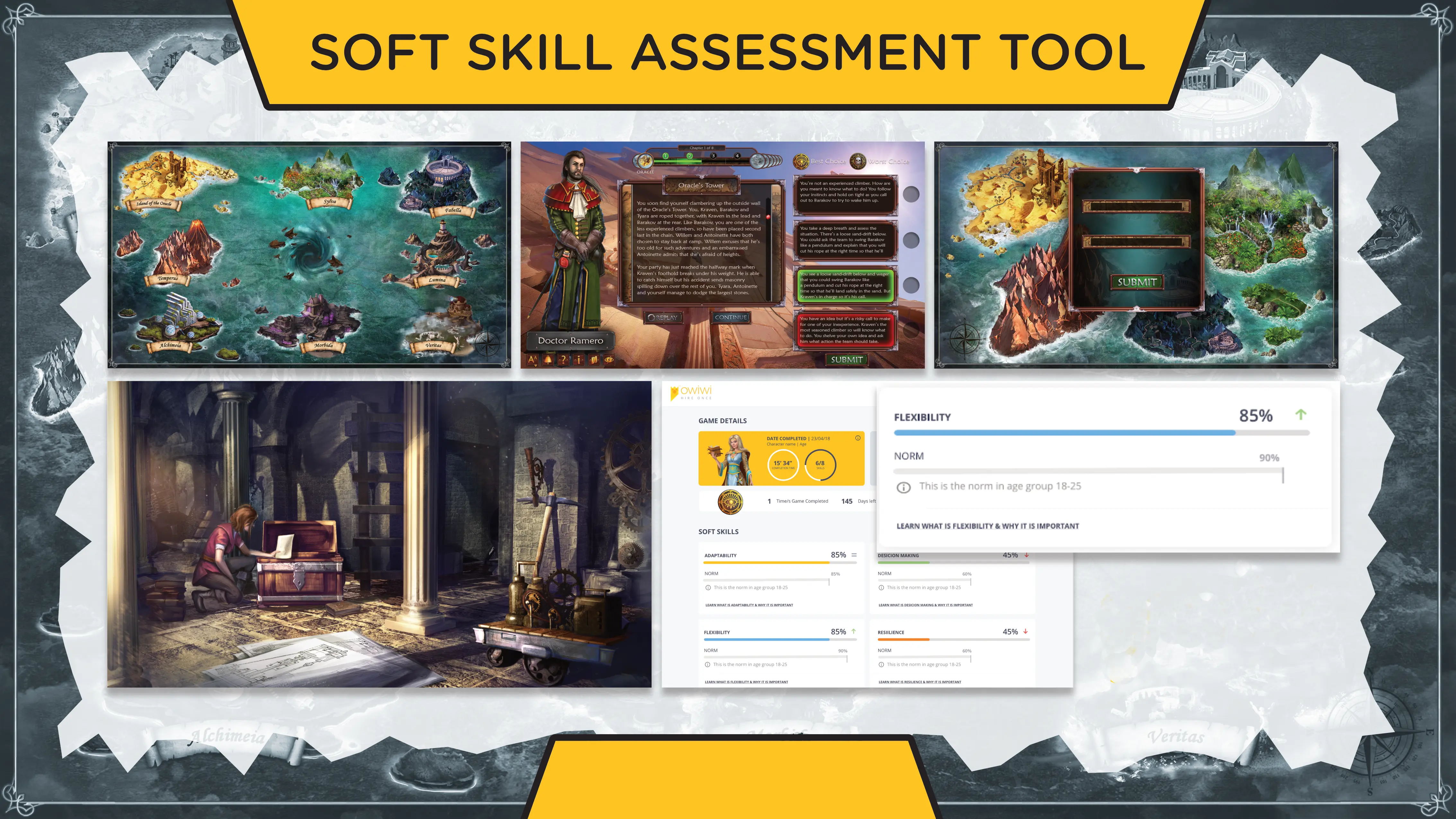
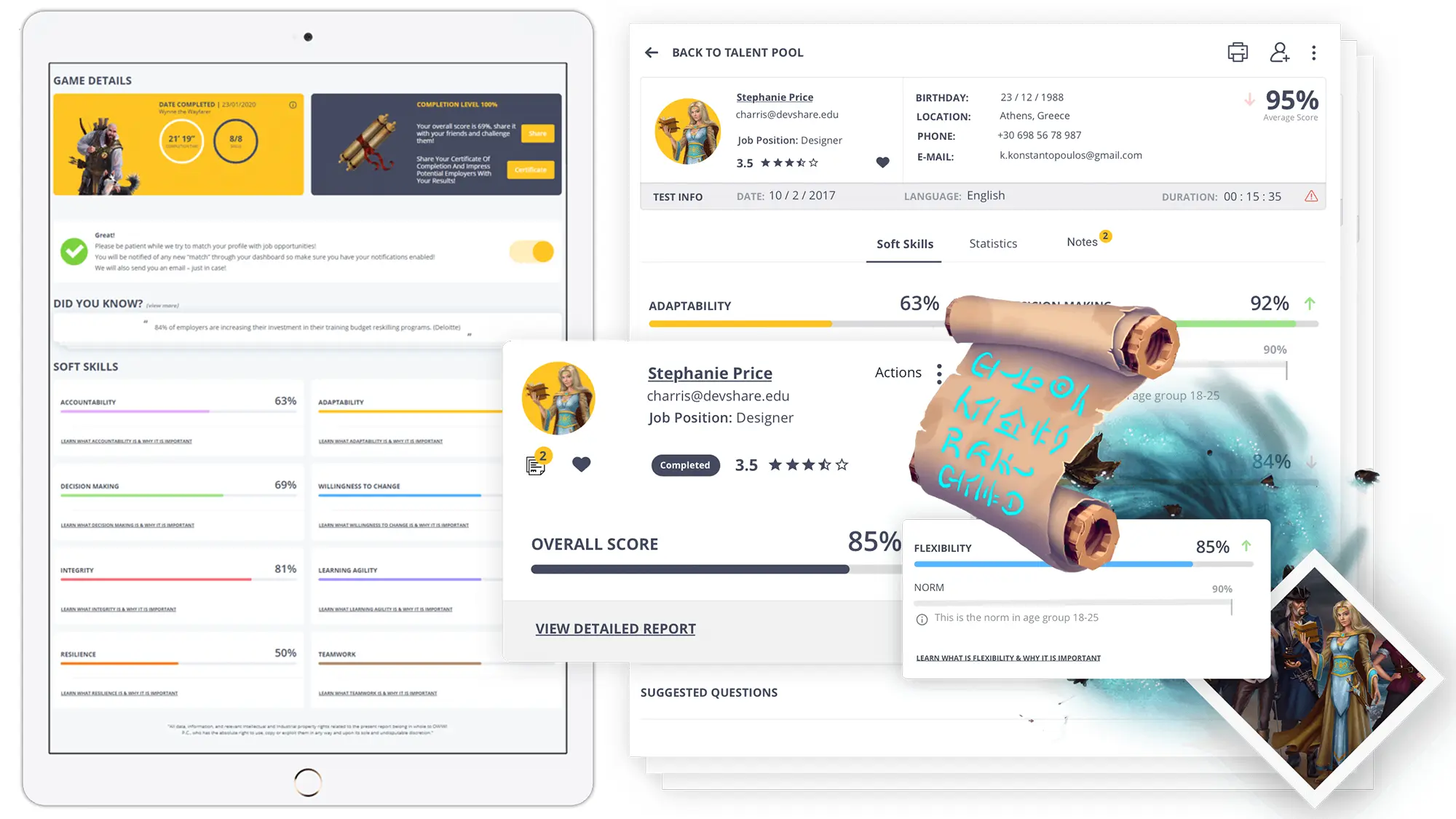
Owiwi — Gamified Hiring Success
The team helped Owiwi build a vivid, story-driven soft-skills assessment that boosts engagement and reveals real candidate behavior. Art, animation, and UX upgrades strengthened the entire platform. Read the full case study.
How to Use Gamification in Recruitment with Game-Ace
Recruiters looking for stronger candidate insights often turn to gamified tools that highlight real behavior instead of self-reported traits. Game-Ace supports that goal by designing custom assessments built around practical tasks, short simulations, and interactive decision checkpoints.
Our team adapts mechanics to each role, ensuring that every challenge reflects real responsibilities and produces measurable data. Being a custom game development company, Game-Ace delivers tailored scenarios that work across devices and help recruiters screen large applicant pools quickly and fairly.
Contact us for a deeper look at how gamification can strengthen your hiring flow.
How to Create Crypto Casino Games the Right Way
AI Recruitment Games: From Real-Time Assessments to Better Hiring Outcomes
Games for Business: Proven Strategies for Engagement and Growth
How to Design Learning Games for Kids That Teach Real-World Skills
Level Up Learning: How Game-Based Learning Drives Real Results